The Critical Difference™

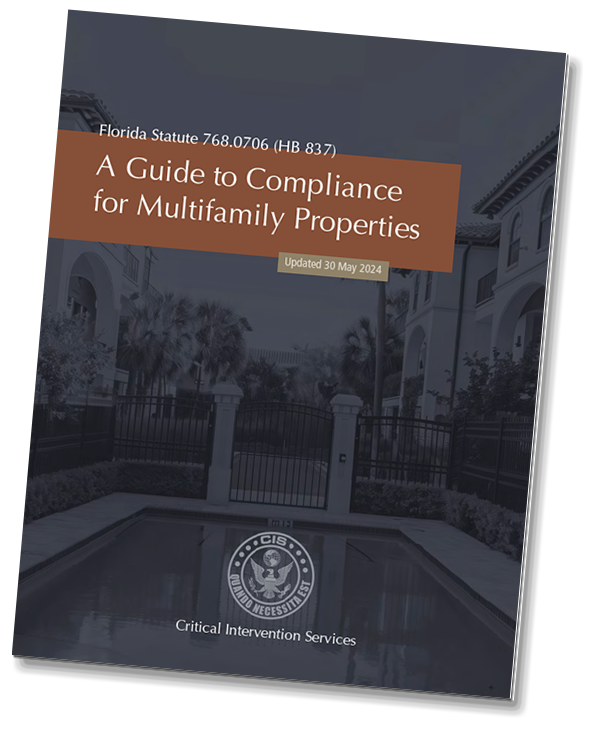
Florida Statute 768.0706: A Guide to Compliance for Multifamily Properties

Florida CPTED Assessments Under Fla. Stat. 768.0706 (HB 837): Questions Property Owners Ask

Since Florida Statute 768.0706 (HB 837) took effect, our consultants have fielded the same questions from property owners, management companies, and legal counsel across Florida — during assessments, after webinars, and in the first minutes of consultation calls. The following answers address the questions we hear most often, drawing on our experience conducting hundreds of CPTED assessments of multifamily properties throughout the state. Each answer is intentionally brief; where a subject deserves deeper treatment, we link to the relevant part of our compliance guide or published analysis. If your question isn’t answered here, contact us — there is no charge for an initial consultation.

Section A — The Assessment and the Law

What is a Florida CPTED assessment under Fla. Stat. 768.0706?

A CPTED (Crime Prevention Through Environmental Design) assessment is a systematic evaluation of a property’s physical environment against established crime prevention principles — encompassing lighting adequacy, landscaping and sightlines, camera coverage, access control, dwelling unit hardware, and conditions contributing to physical disorder. Under Fla. Stat. 768.0706 (the statute created by HB 837), a multifamily residential property seeking a presumption against liability for third-party criminal acts must have an assessment no more than three years old, performed by a law enforcement agency or a Florida CPTED Practitioner (FCP) designated by the Florida Crime Prevention Training Institute. Although the statute itemizes seven specific physical security measures, the CPTED assessment itself is considerably broader — properties will be evaluated against environmental design conditions well beyond the itemized list, and should expect recommendations accordingly.

Is HB 837 the same as Florida Statute 768.0706?

Functionally yes, and the terms are used interchangeably in practice — but the distinction is worth understanding. HB 837 was the broad tort reform bill passed by the Florida Legislature in March 2023, addressing far more than premises security (e.g., comparative negligence standards, attorney fee provisions, and insurance bad-faith rules). Florida Statute 768.0706 is the specific statute the bill created governing security measures for multifamily residential properties. In the first years after passage, nearly everyone referenced “HB 837”; as the framework has matured, the statute citation has become the standard reference among attorneys, insurers, and practitioners. When evaluating an assessor or reviewing documentation, the correct statutory reference is Fla. Stat. 768.0706 — a report citing only the bill number is not defective, but precise statutory citation is one small indicator of a practitioner who works with the statute regularly.

What is the presumption against liability under Fla. Stat. 768.0706?

The owner or principal operator of a multifamily residential property that substantially implements the security measures defined in the statute receives a presumption against liability for criminal acts committed on the premises by third parties — meaning persons other than the owner’s or operator’s employees or agents. In practical terms, when a negligent security claim arises from a third-party crime, a compliant property begins the litigation from a materially stronger position: the plaintiff must overcome the presumption rather than the property defending from a neutral posture. The presumption is not automatic and it is not immunity. The statute explicitly places the burden of proof on the owner or principal operator to demonstrate substantial implementation, which is why documentation practices matter as much as the physical measures themselves.

See also Section E (Litigation and Documentation).

Is compliance mandatory for Florida apartment properties?

No — and this is one of the most common misunderstandings we encounter. Fla. Stat. 768.0706 imposes no penalty for non-compliance; it is a voluntary framework that offers a significant benefit (the presumption against liability) to properties that meet its conditions. A property owner may lawfully decline to pursue compliance. That said, the practical calculus has shifted since 2023: plaintiff attorneys evaluating negligent security cases now routinely examine whether a property qualified for the presumption, insurers increasingly ask about compliance status during underwriting, and institutional buyers factor it into due diligence. The question for most owners is not whether compliance is required, but whether the liability protection justifies the investment — a question that begins with understanding what your specific property would need to correct.

Which properties does the statute apply to?

The statute’s framework applies to multifamily residential properties, defined as residential properties with five or more dwelling units — encompassing apartment communities, townhome communities, and condominiums. Smaller residential properties (e.g., duplexes, triplexes, and fourplexes) fall outside the framework, as do commercial and hospitality properties, which remain governed by conventional premises liability standards. For condominium and HOA-governed communities, an honest caveat is in order: the statute addresses the “owner or principal operator” (language written with rental communities in mind) and how its obligations apply to an association governing individually owned units involves ambiguities the statute does not resolve. Condominium boards considering compliance should involve association counsel early, both on the applicability question and on the governance decisions the process will require. If your portfolio spans qualifying and non-qualifying properties, compliance decisions can be made property by property; the statute evaluates each property independently.

What are the three categories of requirements under 768.0706(2)?

The statute defines compliance through three paragraphs, and understanding the architecture matters because the burden of proof runs through all three. Paragraph (a) itemizes seven physical security measures — the hardware layer. Paragraph (b) requires a crime prevention through environmental design assessment no more than three years old, performed by a law enforcement agency or a designated Florida CPTED Practitioner, with the property remaining in substantial compliance with that assessment. Paragraph (c) requires proper crime deterrence and safety training for all current employees, with new employees trained within 60 days of hire. The three categories are conjunctive — the presumption requires all three, and a property that satisfies the hardware list while neglecting the assessment or training obligations has not positioned itself for the protection. Each category also generates its own documentation trail, which is what a court will actually examine.

What are the seven physical security measures in paragraph (2)(a)?

The seven itemized measures are: (1) a security camera system at points of entry and exit that records and maintains retrievable footage for at least 30 days, sufficient to assist in offender identification and apprehension; (2) a lighted parking lot illuminated at an average of at least 1.8 foot-candles per square foot at 18 inches above the surface, from dusk until dawn or controlled by photocell; (3) lighting in walkways, laundry rooms, common areas, and porches from dusk until dawn or by photocell; (4) at least a 1-inch deadbolt on each dwelling unit door; (5) a locking device on each window, exterior sliding door, and other doors not used for community purposes; (6) locked gates with key or fob access along pool fence areas; and (7) a peephole or door viewer on dwelling unit doors lacking a window or adjacent window. Several of these contain interpretive questions the statute leaves open — most notably what constitutes a “point of entry and exit.”

What is CPTED?

Crime Prevention Through Environmental Design is the planned use of the physical environment to deter crime and reduce criminal opportunity — a discipline that predates the Florida statute by roughly five decades and is practiced internationally. Rather than relying solely on guards, alarms, and hardware, CPTED works through the design and management of the environment itself: ensuring people can see clearly as they move through a property, channeling access through observable routes, defining the boundary between public and private space, and maintaining conditions that communicate the property is cared for and monitored. The Florida Legislature adopted CPTED as the evaluative framework for 768.0706 because it provides an established, documentable methodology — which is also why the assessment examines conditions well beyond the statute’s seven itemized measures.

What are the core CPTED principles practitioners evaluate?

Florida CPTED practice centers on several foundational principles. Natural surveillance — facilitating the ability to see clearly in all directions while moving through the property and limiting offender concealment opportunities; the common field guideline is the two-foot, six-foot rule (shrubbery at or below 24 inches, tree canopies no lower than six feet). Illumination — a major component of CPTED that supports surveillance after dark, evaluated not only against the statute’s parking lot threshold but against criteria established by the Illuminating Engineering Society (IES), encompassing qualities the statute never addresses (e.g., light uniformity, contrast ratio, glare, and color rendition). Natural access control — channeling movement through designed, observable points of passage rather than uncontrolled routes. Territorial definition — design cues that distinguish private community space from public space and communicate ownership. And maintenance — because physical disorder (broken fixtures, damaged fencing, litter, missing screens) signals vulnerability to potential offenders, while a well-maintained environment communicates the community is monitored and cared for. During a 768.0706 assessment, your property is evaluated against all of these, not merely the statute’s hardware list.

Section B — Who Performs the Assessment

Who is qualified to perform a 768.0706 CPTED assessment?

The statute recognizes exactly two sources: a law enforcement agency, or a Florida Crime Prevention Through Environmental Design Practitioner (FCP) designated by the Florida Crime Prevention Training Institute within the Department of Legal Affairs. This is a closed list. An assessment performed by anyone else — regardless of experience, credentials, or report quality — does not satisfy paragraph (2)(b), and a property relying on such an assessment has a compliance gap it may not discover until litigation. Before engaging an assessor, verify the FCP designation directly; a practitioner working actively in this space will provide verification without hesitation. Many properties engage an FCP for the documented assessment even where a law enforcement option exists, for reasons of scheduling, scope, and documentation depth addressed below.

What is a Florida CPTED Practitioner (FCP), and how is the designation earned?

The FCP designation is conferred by the Florida Crime Prevention Training Institute (FCPTI), which operates under the Florida Attorney General’s Office, upon completion of the Institute’s prescribed basic and advanced CPTED training curriculum. The designation establishes that the practitioner has been trained in the specific CPTED doctrine and assessment methodology the State of Florida recognizes — which matters under 768.0706 because the statute names FCPTI-designated practitioners as one of only two qualified assessment sources. The designation itself is a baseline, not a ceiling: practitioners vary considerably in field experience, report quality, and litigation exposure. When comparing assessors, the FCP designation answers the threshold qualification question; experience with multifamily properties, documentation practices, and familiarity with how assessments perform under legal challenge answer the rest.

Can any security consultant perform the assessment?

No. Although many capable security consultants conduct property assessments, Fla. Stat. 768.0706(2)(b) is specific: the assessment must be performed by a law enforcement agency or an FCPTI-designated Florida CPTED Practitioner. A general security assessment — however thorough — performed by a consultant without the FCP designation does not satisfy the statute. We have encountered situations where property owners believed themselves compliant on the basis of a prior security survey that did not meet the statutory sourcing requirement. The distinction can be consequential: the burden of proof rests on the owner, and the qualification of the assessor is among the first things a plaintiff attorney will examine. If your property has an existing assessment, verifying the assessor’s designation status as of the assessment date is a five-minute check worth making now rather than during discovery.

Should I use a free law-enforcement CPTED survey or hire a Florida CPTED Practitioner?

Both satisfy the statute, and for some properties a law enforcement survey is a reasonable path. The practical differences lie in scheduling, scope, and documentation. Agency CPTED programs vary by jurisdiction in availability and depth; some produce brief observational reports, while 768.0706 litigation readiness turns on documentation — a defined methodology, standards references, measured lighting data, and defensible presentation of findings. To bolster readiness for legal challenge, most property owners also desire a documented verification of the paragraph (2)(a) conditions — a matter beyond the scope of normal CPTED assessments. Because the statute places the burden of proof on the owner, the depth of the assessment record is not a cosmetic difference; it is the evidence you will produce when the presumption is challenged. There is also the question of what precedes the documented assessment: documenting non-compliance prematurely can itself create a liability record, which is why we recommend a preliminary review before any formal assessment regardless of who performs it.

See also Section E (Litigation and Documentation).

Section C — What Assessments Actually Find

Will my property pass the assessment?

The question assumes a pass/fail structure the process doesn’t have — an assessment documents conditions and recommends corrections; compliance is achieved by implementing the recommendations (or justifiably declining low-benefit measures) and maintaining the result. That said, owners asking this question usually want to know whether deficiencies are likely, and the honest answer is yes. In our recent analysis of assessment findings across 30 Florida multifamily properties, every property — 100% — presented at least one deficiency requiring correction. Deficiency findings are the expected starting point of the compliance process, not a failure of it; the statute’s “substantial compliance” language anticipates exactly this sequence of assessment, correction, and documentation. The productive version of the question is what your property will most likely need to correct and what those corrections cost — both of which our published findings data addresses in detail.

What deficiencies are found most often?

Across our recent 30-property findings analysis, the most prevalent deficiencies were: lighting controls accessible to residents or staff rather than secured or photocell-operated, found on 92% of properties; parking lot illumination requiring redesign rather than spot repair to meet the 1.8 foot-candle requirement and IES guidelines, at 81%; camera coverage gaps at designated points of entry and exit, at 77%; and landscaping conditions violating natural surveillance guidelines (the two-foot, six-foot rule), which appeared in some form on effectively every property assessed. The pattern worth noting is that the most common failures are not the measures owners worry about most — deadbolts and peepholes are usually in order — but the environmental and operational conditions that degrade quietly over years: vegetation growth, lighting drift, and controls nobody secured because nobody was asked to.

Why are "dusk until dawn" lighting controls such a common failure?

The statute requires that lighting in walkways, laundry rooms, common areas, and porches operate from dusk until dawn or be controlled by a photocell or similar device — and the failure is rarely outdoors. Parking lot and breezeway lighting is almost always operated by photocells or timers. The failure usually lives inside indoor community spaces (e.g., fitness rooms, laundry rooms, clubhouses) where lighting is controlled by motion-sensing switches or by ordinary wall switches accessible to residents and staff. Each defeats the requirement by a different mechanism — a motion sensor leaves the space dark whenever it is unoccupied, illuminating only on entry rather than from dusk until dawn, while an accessible wall switch lets anyone place the space out of compliance by simply turning the lights off, with the property having no systematic way of knowing it happened. This condition appeared on 92% of properties in our findings analysis. The corrections are straightforward: locked switch and thermostat boxes, or direct-wiring the fixtures. Some newly constructed properties balancing compliance against electricity costs have installed two lighting circuits — a low-level set that maintains the room at a defensible illumination level at all hours, and a second, motion-activated set that operates when the room is occupied. Nearly every owner we speak with is confident about their lighting; nearly every property has this condition somewhere.

Do newly constructed properties pass automatically?

No — newer construction arrives cleaner but not compliant. Building codes govern life safety and construction standards; they do not incorporate CPTED criteria such as sightline preservation, lighting uniformity for identification purposes, or camera coverage of every designed point of entry and exit. In our findings analysis, recently constructed properties presented fewer deficiencies than older communities but were not free of them — landscaping installed per the architect’s plan frequently violates the two-foot, six-foot rule as it matures, lighting designed to code minimums may not meet the statute’s 1.8 foot-candle — or the 3.0 foot-candle level recommended by IES guidelines — as measured, and camera plans drawn before the statute rarely map to the statute’s conception of entry and exit points. For new construction and major renovations, the cost-effective moment for CPTED input is design review, before conditions are built that are expensive to correct afterward.

Section D — Timing, Cost, and Process

What do corrections typically cost?

Correction costs cluster into three tiers. Landscaping corrections — pruning, removal, and replacement to restore natural surveillance — typically run $1,000 to $7,000. Camera system corrections range from roughly $2,000 for coverage additions to $50,000 or more where systems require replacement to meet retention and identification requirements. Lighting is the dominant budget item when redesign is required: parking lot lighting projects range from approximately $10,000 to $100,000 or more depending on property size and existing infrastructure, and cost data shared by a lighting contractor we work with supports a planning heuristic of roughly $321 per unit for lighting remediation. Two qualifications matter: these are remediation costs, distinct from the assessment fee itself, and no property incurs all of them — the cost-benefit ranking in a properly prepared report exists precisely so owners can prioritize corrections by benefit relative to cost. Our published budgeting analysis breaks these figures down by deficiency category.

We missed the January 1, 2025 deadline — what now?

Proceed thoughtfully, and involve counsel — because the statute answers this question less clearly than most commentary suggests. January 1, 2025 was the date by which the CPTED assessment and employee training conditions had to be in place. The prevailing understanding in the industry is that a property achieving compliance now positions itself for the presumption with respect to incidents going forward, and many owners are proceeding on that basis. But the statute does not expressly address late compliance, its drafting leaves room for stricter readings of the deadline, and the question will ultimately be settled by the courts — which is why how the presumption applies to your property is a question for your attorney, not your assessor. Two things are not in doubt. An incident that occurred while the property was non-compliant is an exposure already incurred, and every month of delay extends it. And a documented assessment with implemented corrections strengthens a property’s defensive position under ordinary negligence principles on any reading of the statute — the compliance work is worth doing regardless of how the deadline question resolves.

How long does the compliance process take end to end?

The timeline is governed almost entirely by the scope of corrections, not by the assessment itself. A typical sequence runs: preliminary review to identify deficiencies before anything is formally documented; correction of identified conditions; the documented CPTED assessment; and training rollout for employees. For a property in good condition, the entire sequence can conclude within several weeks. Where corrections are substantial, the long pole is nearly always lighting — redesign projects involve photometric planning, fixture procurement, and electrical work that can extend the schedule by months, which is one reason lighting deficiencies deserve early attention in the sequence. Landscaping and hardware corrections rarely constrain the timeline. Owners planning across a portfolio should also account for assessor scheduling and the training obligation for existing staff, both of which can run in parallel with physical corrections rather than after them.

What does "substantial compliance" mean when it is challenged in court?

The statute requires that the property “remain in substantial compliance with the assessment” — and deliberately does not define the phrase, which makes it a predictable point of contention in litigation. Because the burden of proof rests on the owner, the operative question is not what substantial compliance means in the abstract, but what evidence the property can produce: an item-by-item record demonstrating which recommendations were implemented, and a documented, defensible rationale for any that were not. The statute does not require implementing every proposed measure; owners may justifiably decline improvements where benefit is low relative to cost — but that judgment must exist in the record, not be reconstructed after a claim. This is why our reports rank every recommendation on a cost-benefit scale, including a category for conditions that cannot reasonably be changed. A property that files the assessment and moves on has not achieved substantial compliance; it has deferred the question to a courtroom, where it will be answered from whatever record exists.

What triggers reassessment before the three-year mark?

The statute sets a maximum assessment age of three years, but several circumstances may justify earlier reassessment. The most common in our practice is voluntary: after completing major corrective improvements, some owners want documented third-party verification that the corrections were properly implemented. The statute does not require it, but for clients who want the added layer of quality control and legal reinforcement, a verification assessment converts “we fixed it” into an independent record that the property’s compliance posture was confirmed after the work. Material changes to the property are the other principal trigger — renovations, lighting or camera system changes, new construction phases, or significant landscaping alterations can render the existing assessment’s findings stale — as are ownership and management transitions, since the incoming operator inherits both the compliance obligation and the documentation burden. Between assessments, internal inspection on a regular basis is the essential discipline: condition reversion is more aggressive than most owners expect. In our findings work, corrected landscaping commonly reverts within six to twelve months where maintenance contracts lack CPTED specifications, and none of the properties in our analysis had such specifications in their contracts. Lighting systems degrade on their own schedule — failed lamps, obstructing tree growth — which regular nighttime inspection catches and nothing else does. A brief internal review against the assessment’s recommendations costs little and is the difference between maintaining compliance and rediscovering non-compliance.

Section E — Litigation and Documentation

Who bears the burden of proof under 768.0706?

The property owner or principal operator — explicitly. The statute states that the burden of proof is on the owner or principal operator to demonstrate substantial implementation of the security measures. This provision shapes everything about how compliance should be operated. It is not sufficient for the property to be compliant; the property must be able to prove it was compliant, item by item, as of the relevant date. In practice this means maintaining organized records of improvements made in response to the assessment — work orders, invoices, vendor documentation such as camera installation plans and photometric drawings — along with training completion records and inspection logs. The ability to produce a complete compliance record promptly in response to a discovery request is frequently decisive. Properties that implement the physical measures but neglect the records have done the expensive half of compliance and skipped the half that wins the argument.

Does compliance guarantee protection from negligent-security lawsuits?

No, and any assessor who suggests otherwise should be pressed on the point. The statute provides a presumption against liability — a substantial procedural advantage, not immunity. The presumption applies to criminal acts by third parties; it does not extend to acts by the property’s own employees or agents. It is also conditioned on the compliance record: plaintiff attorneys are expected to attack the presumption by attacking the compliance itself — the qualification of the assessor, the quality of the assessment, the completeness of implementation, and whether conditions were maintained after the assessment date. A property with a rigorous assessment, documented corrections, and organized records presents a hard target for that strategy; a property with a thin report and no maintenance trail presents an inviting one. Compliance is best understood as converting an open-ended liability exposure into a defensible, evidence-based position — which is valuable precisely because it is not automatic.

How does a CPTED assessment actually function in litigation?

The assessment and its implementation record become the evidentiary foundation for the presumption. The report establishes that a qualified practitioner evaluated the property against recognized standards; the implementation documentation establishes that the owner acted on the findings; and together they demonstrate the affirmative case the burden-of-proof provision demands. Because the opposing strategy is to discredit the assessment, its methodology must withstand expert scrutiny — which is why our assessment practices are built for challenge rather than merely for filing: illumination measurements taken with calibrated, NIST-certified light meters and data-logged to remove human error from the record, reports accompanied by appendixes defining the CPTED standards applied and the authoritative sources supporting each observation, and recommendations ranked on a cost-benefit scale that documents the reasoning behind implementation decisions — including conditions that cannot reasonably be changed. In litigation, the difference between an assessment and a defensible assessment is the difference between having a report and having evidence.

What should a defensible CPTED assessment report contain?

Owners rarely see a second report to compare against, so it is worth knowing what the first one should include. A report prepared with litigation in mind contains: a description of the assessment methodology; appendixes defining the CPTED standards applied, with citations to authoritative sources cross-referenced throughout the body; an itemized verification of each condition defined in paragraph (2)(a); measured lighting data — a lighting map identifying illumination levels throughout the property, with observations on contrast, glare, and maintenance conditions; photographic documentation of findings; and recommendations ranked by cost relative to benefit, including explicit notation of conditions inherent to the property’s original design that cannot reasonably be changed. That last element matters more than it appears: omitting unchangeable conditions from a report creates an opening for an opposing expert to characterize the assessment as incomplete. A report is not merely a compliance artifact — it is a document that may one day be read aloud to a jury, and it should be prepared by someone who has been in that room.

Additional Articles Related to Florida Statute 768.0706 

Contact Us 

Contact us to schedule a free consultation about achieving compliance with Fla. Stat. § 768.0706 (HB 837) by calling Tel. +01 (727) 461-9417 or by completing the following form:

Craig

The Words of Our Clients and Peers

Toll-free: (800) 247-6055 | Tampa Bay Area: (727) 461-9417 | Hillsborough: (813) 910-4247 | Orlando: (407) 420-7945

The staff of CIS is dedicated to providing each client with the finest quality of protective services available.

Our commitment and dedication to professional, ethical, and protocol conscious service is our trademark.

Preserving, projecting, and protecting our clients’ image and interests is our business.

Copyright © 2026 Critical Intervention Services, Inc. ® Florida “A” License: A9900261