Craig Gundry Presents “Fla. Stat. 768.0706: Three Years Later” at FLDOCA Spring Conference
On May 8, 2026, Craig S. Gundry, PSP, FCP, of Critical Intervention Services participated in a panel of field practitioners discussing Florida Statute 768.0706 at the Florida Design Out Crime Association (FLDOCA) Spring Conference in Orlando. The panel, presented under the title “Fla. Stat. 768.0706: Three Years Later,” examined the state of multifamily compliance three years after the statute’s passage as part of HB 837 in 2023. Joining Craig on the panel were Leon Lipsick, FCP, West Palm Beach Housing Authority; Carlos Austin; and Stephen Davis.
The FLDOCA Spring Conference was held at the DoubleTree by Hilton Orlando at SeaWorld, co-located with Florida Crime Prevention Training Institute (FCPTI) courses conducted during the same week. The conference program brought together Florida CPTED practitioners, law enforcement crime prevention specialists, and security professionals from across the state, with additional presentations addressing the USCA CPTED National Design Guidelines and the integration of CPTED into community development planning.
Craig’s presentation reviewed the current status of 768.0706 compliance across Florida’s multifamily sector. Although an increasing number of private equity and property management companies have pursued compliance since the statute’s enactment, the overall number remains low, with much of the existing interest driven by insurance brokers and risk advisors rather than the property operators themselves.
The presentation also addressed HB 1423 and SB 956, companion bills introduced during the legislative session that would have eliminated the presumption against liability for properties where two or more enumerated crimes were reported in the 24 months preceding an incident. Both bills were stopped, but their introduction signals that the statute’s liability framework will remain a subject of legislative attention.
A substantial portion of the discussion focused on the unresolved definitional questions in F.S. 768.0706(2)(a) — ambiguities that have received no substantive clarification since 2023. These include what constitutes a “point of entry and exit” for camera coverage purposes, the unusual 1.8 foot-candle at 18-inch measurement standard for parking lot illumination, and the statute’s undefined use of the term “porches” in its common-area lighting requirement. In the absence of case law or legislative guidance, CIS has developed documented interpretive positions on each of these questions for use in our assessment practice, and the panel discussed how practitioners across the state are navigating the same interpretive gaps.
The presentation concluded with a review of CPTED assessment practice in multifamily environments — natural surveillance and obstructive vegetation, offender concealment opportunities, lighting deficiencies commonly documented during nighttime inspections, territoriality measures, and maintenance conditions — along with practical guidance for maintaining substantial compliance over time through documentation systems, sustained employee training, landscaping contract specifications, and monthly inspection protocols.
CIS thanks FLDOCA for organizing the program and our fellow panelists for a candid exchange on the practical realities of statutory compliance. Craig serves on the FLDOCA board of directors, and CIS remains active in the association’s work advancing CPTED practice throughout Florida.
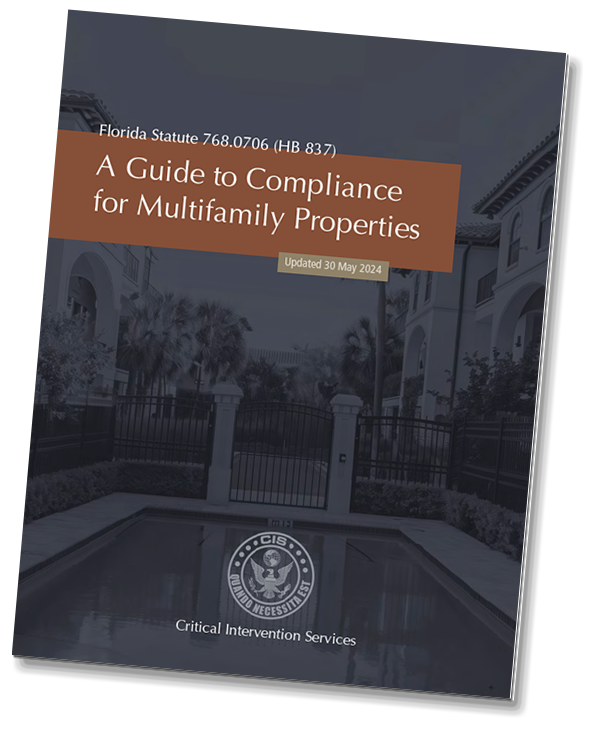
For property owners and operators seeking guidance on 768.0706 compliance, our six-part compliance guide and CPTED assessment services page.
Contact Us
Contact us for a free consultation about Fla. Stat. § 768.0706 compliance by calling Tel. +01 (727) 461-9417 or by completing the following form: