
Craig Gundry Presents “Fla. Stat. 768.0706: Three Years Later” at FLDOCA Spring Conference

Craig Gundry Presents “Fla. Stat. 768.0706: Three Years Later” at FLDOCA Spring Conference

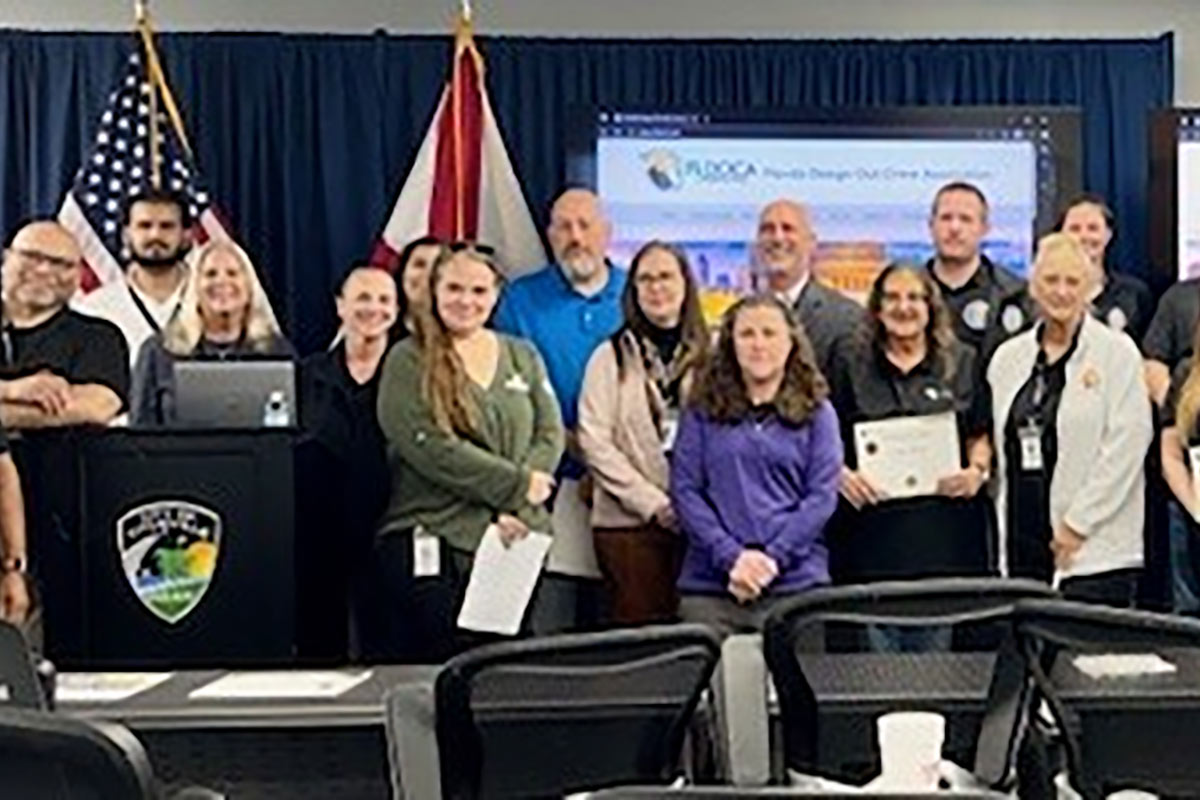
On May 8, 2026, Craig S. Gundry, PSP, FCP, of Critical Intervention Services participated in a panel of field practitioners discussing Florida Statute 768.0706 at the Florida Design Out Crime Association (FLDOCA) Spring Conference in Orlando. The panel, presented under the title “Fla. Stat. 768.0706: Three Years Later,” examined the state of multifamily compliance three years after the statute’s passage as part of HB 837 in 2023. Joining Craig on the panel were Leon Lipsick, FCP, West Palm Beach Housing Authority; Carlos Austin; and Stephen Davis.

The FLDOCA Spring Conference was held at the DoubleTree by Hilton Orlando at SeaWorld, co-located with Florida Crime Prevention Training Institute (FCPTI) courses conducted during the same week. The conference program brought together Florida CPTED practitioners, law enforcement crime prevention specialists, and security professionals from across the state, with additional presentations addressing the USCA CPTED National Design Guidelines and the integration of CPTED into community development planning.

Craig’s presentation reviewed the current status of 768.0706 compliance across Florida’s multifamily sector. Although an increasing number of private equity and property management companies have pursued compliance since the statute’s enactment, the overall number remains low, with much of the existing interest driven by insurance brokers and risk advisors rather than the property operators themselves.

The presentation also addressed HB 1423 and SB 956, companion bills introduced during the legislative session that would have eliminated the presumption against liability for properties where two or more enumerated crimes were reported in the 24 months preceding an incident. Both bills were stopped, but their introduction signals that the statute’s liability framework will remain a subject of legislative attention.

A substantial portion of the discussion focused on the unresolved definitional questions in F.S. 768.0706(2)(a) — ambiguities that have received no substantive clarification since 2023. These include what constitutes a “point of entry and exit” for camera coverage purposes, the unusual 1.8 foot-candle at 18-inch measurement standard for parking lot illumination, and the statute’s undefined use of the term “porches” in its common-area lighting requirement. In the absence of case law or legislative guidance, CIS has developed documented interpretive positions on each of these questions for use in our assessment practice, and the panel discussed how practitioners across the state are navigating the same interpretive gaps.

The presentation concluded with a review of CPTED assessment practice in multifamily environments — natural surveillance and obstructive vegetation, offender concealment opportunities, lighting deficiencies commonly documented during nighttime inspections, territoriality measures, and maintenance conditions — along with practical guidance for maintaining substantial compliance over time through documentation systems, sustained employee training, landscaping contract specifications, and monthly inspection protocols.

CIS thanks FLDOCA for organizing the program and our fellow panelists for a candid exchange on the practical realities of statutory compliance. Craig serves on the FLDOCA board of directors, and CIS remains active in the association’s work advancing CPTED practice throughout Florida.

For property owners and operators seeking guidance on 768.0706 compliance, our six-part compliance guide and CPTED assessment services page.


Contact Us 

Contact us for a free consultation about Fla. Stat. § 768.0706 compliance by calling Tel. +01 (727) 461-9417 or by completing the following form:
Craig

CIS Presents CPTED and Fla. Stat. 768.0706 Program at ASIS West Florida Chapter Luncheon

CIS Presents CPTED and Fla. Stat. 768.0706 Program at ASIS West Florida Chapter Luncheon

On September 18, 2025, Craig S. Gundry, PSP, FCP, Senior Partner and Chief Security Strategist at Critical Intervention Services, presented a program on Crime Prevention Through Environmental Design (CPTED) and Florida Statute 768.0706 during a luncheon meeting of the ASIS International West Florida Chapter. The program was attended by approximately two dozen security professionals from the Tampa Bay region representing corporate security, consulting, and law enforcement backgrounds.

ASIS International is the world’s largest association for security management professionals and the certifying body for the CPP, PSP, PCI, and APP designations. The West Florida Chapter serves practitioners throughout the Tampa Bay area, and its meetings provide a forum for continuing education on developments affecting the profession — a fitting audience for a statute that has created an entirely new category of assessment work for Florida security practitioners.

The presentation opened with an overview of F.S. 768.0706 and the presumption against liability it provides to multifamily property owners and operators who substantially implement its requirements: the seven physical security measures enumerated in 768.0706(2)(a), a CPTED assessment performed within the previous three years by a law enforcement agency or a Florida CPTED Practitioner (FCP), and proper crime deterrence and safety training for all employees, with new employees trained within 60 days of hire.

Because the audience consisted of working security professionals rather than property operators, a significant portion of the program addressed the statute’s unresolved interpretive questions and the positions CIS has adopted for verifying compliance in our assessment practice. These include the undefined scope of “points of entry and exit” for camera coverage — which CIS interprets as all designed entrances through the legal boundary separating exterior public space from the private property — along with the statute’s unusual 1.8 foot-candle at 18-inch parking lot measurement standard, the ambiguous meaning of “porches” in the common-area lighting requirement (which CIS interprets to include breezeways and exterior apartment entrances, but not porches inside leased private living spaces), and the question of what proximity of a light source satisfies the statute’s “lighting in” language. With no case law yet interpreting these provisions, documented and defensible interpretive positions are essential for any practitioner conducting assessments under the statute.

The balance of the program covered CPTED principles as applied to multifamily properties — natural surveillance, natural access control, territorial reinforcement, and maintenance — illustrated with field photography and light meter data from CIS assessments across Florida. Examples included obstructive vegetation conditions, offender concealment opportunities created by structural design, the full spectrum of lighting deficiencies documented during nighttime inspections, and territoriality measures ranging from celebrated entryways to restrictive signage, including a caution regarding signage language that creates a false expectation of security.

CIS thanks the ASIS West Florida Chapter and its officers for the invitation and the engaging discussion that followed. Several of our consultants maintain longstanding involvement with ASIS International, and chapter programs like this one remain one of the best venues for advancing professional practice in our region.


Contact Us 

Contact us for a free consultation about Fla. Stat. § 768.0706 compliance by calling Tel. +01 (727) 461-9417 or by completing the following form:

Craig

CIS Presents CPTED for Multifamily Properties in HAI Group Security Webinar

CIS Presents CPTED for Multifamily Properties in HAI Group Security Webinar

On July 15, 2025, Craig S. Gundry, PSP, cATO, FCP, of Critical Intervention Services delivered a 40-minute presentation on Crime Prevention Through Environmental Design (CPTED) for multifamily properties as part of HAI Group’s webinar, “Strengthening Security in Multifamily Housing: Strategies and Success Stories.” The free webinar paired CIS’s presentation on CPTED principles with a case study on the West Palm Beach Housing Authority’s security initiative, presented by Leon Lipsick, followed by live Q&A with attendees.

Play Video

HAI Group is a member-owned insurance organization founded by public housing authorities nearly four decades ago and today serves as a leading provider of property and casualty insurance to the public and affordable housing industry nationwide. The webinar was inspired by the release of HAI Group’s Housing Security and Law Enforcement Operations Guide, a free resource offering guidance on crime prevention, building community trust, and strengthening partnerships with law enforcement.

Craig’s presentation introduced CPTED as a multi-disciplinary approach to crime prevention that uses urban and architectural design and the management of built and natural environments to reduce victimization, deter offender decisions that precede criminal acts, and build territorial control among residents. The program was organized around the four key CPTED principles — natural surveillance, natural access control, territorial reinforcement, and maintenance — with extensive field photography from CIS assessments illustrating each concept as it appears on real multifamily properties.

Much of the presentation addressed natural surveillance and its two most common adversaries in multifamily environments: obstructive vegetation and deficient lighting. Using nighttime assessment photography with documented light meter readings, Craig illustrated the full range of lighting problems CIS routinely documents during property assessments — obstructed luminaires, inadequate luminous flux, absent and inoperative lights, glare conditions, and excessive contrast ratios — alongside examples of properties with well-executed lighting. The presentation referenced illumination and contrast ratio criteria from the Illuminating Engineering Society’s Guide for Security Lighting for People, Property, and Critical Infrastructure (2016), the authoritative reference CIS uses when evaluating lighting during CPTED assessments.

The program also examined offender concealment opportunities created by structural design, natural access control through landscaping and terrain barriers, and territorial reinforcement measures including celebrated entryways, wayfinding signage, transition zones, and restrictive signage — with a caution for property operators to be conscious of signage language that contributes to a false expectation of security. The presentation concluded with a review of maintenance conditions and physical disorder, followed by a summary of Florida Statute 768.0706 and its three categories of compliance requirements: the seven physical security measures defined in 768.0706(2)(a), the CPTED assessment requirement, and mandatory crime deterrence and safety training for employees.

Insurance carriers and risk advisors have become one of the most consistent drivers of security improvement in the multifamily sector, and programs like this one reflect the growing recognition that environmental design is among the most cost-effective tools available for reducing crime risk on residential properties. CIS thanks HAI Group for the invitation and the West Palm Beach Housing Authority for sharing its experience putting these principles into practice.

For property owners and operators interested in CPTED assessment services or Florida Statute 768.0706 compliance, see our compliance guide and CPTED services page.

Contact Us 

Contact us for a free consultation about Fla. Stat. § 768.0706 compliance by calling Tel. +01 (727) 461-9417 or by completing the following form:
Craig

CIS Consultants Featured on the Property Management Law Solutions Podcast

CIS Consultants Featured on the Property Management Law Solutions Podcast

Critical Intervention Services security consultants Craig S. Gundry, PSP, FCP, and Hector Rodriguez, CPP, FCP, were recently featured guests on the Property Management Law Solutions Podcast, hosted by attorney Tim Baldwin. The episode, titled “Liability & Risk Management for Property Management Companies,” was released on June 10, 2025 and is available on all major podcast platforms.

The Property Management Law Solutions Podcast is produced by Property Management Law Solutions, PLLC, a Florida law firm specializing in landlord and property management representation statewide. Tim Baldwin, the firm’s founder, has been practicing law since 2004 and represents some of the largest property management companies in Florida. His podcast addresses the legal and operational issues confronting landlords and property managers, ranging from evictions and lease compliance to insurance and premises liability.

During the interview, we discussed the liability landscape facing property management companies in Florida and the practical measures available to reduce exposure to negligent security claims. Much of the conversation centered on Florida Statute 768.0706 — the multifamily premises liability law established by HB 837 in 2023 — and the framework it provides for property owners seeking a presumption against liability for criminal acts committed by third parties on their premises. As we’ve noted in our published compliance guides, the statute’s seven enumerated physical security measures are only the starting point. The CPTED assessment requirement, the employee training obligation, and the ongoing burden of demonstrating substantial compliance are where most properties encounter difficulty, and these were recurring themes throughout the discussion.

We also addressed the practical relationship between property managers and security consultants when preparing for compliance. Although the statute places the burden of proof on the owner or principal operator, property management companies are typically the parties responsible for day-to-day compliance activities — camera system checks, lighting inspections, landscaping maintenance according to CPTED assessment guidelines, and documentation of improvements. In our experience conducting CPTED assessments across Florida, properties that treat these obligations as an ongoing operational commitment are far better positioned to withstand court scrutiny than those that approach compliance as a one-time checklist.

Conversations like this one reflect a broader point we frequently make with clients: liability risk management in the multifamily sector is fundamentally a collaboration between legal counsel, property operators, and qualified security practitioners. Attorneys like Tim Baldwin understand the litigation environment; our role as Florida CPTED practitioners is ensuring that the physical security conditions and documentation on the ground can support the legal defense when it matters.

The full episode is available on the Property Management Law Solutions Podcast website, Apple Podcasts, Spotify, Amazon Music, and iHeartRadio. We thank Tim Baldwin for the invitation and for his continued work educating Florida’s property management community on these issues.

For more information about CIS’s Florida CPTED assessment services and Fla Stat 768.0706 compliance, visit our compliance guide or contact our office.

Contact Us 

Contact us for a free consultation about Fla. Stat. § 768.0706 compliance by calling Tel. +01 (727) 461-9417 or by completing the following form:

Craig

CIS and S2 Institute Launch Free ‘Proper Crime Deterrence and Safety Training’ for Compliance with Florida Statute 768.0706(2)(c)

CIS and S2 Institute Launch Free ‘Proper Crime Deterrence and Safety Training’ for Compliance with Florida Statute 768.0706(2)(c)

Training Now Available On-Demand at www.HB837training.com 

Clearwater, FL, September 12, 2024 — Critical Intervention Services (CIS), in partnership with the S2 Institute, proudly announces the launch of an on-demand Crime Deterrence and Safety Training program, available now at www.HB837training.com. This comprehensive training is free to the public until January 1, 2025, and is designed to help organizations comply with Florida Statute 768.0706(2)(c). 

A major benefit for management companies: CIS clients who have undergone a Crime Prevention Through Environmental Design (CPTED) assessment will receive unlimited, no-cost access to this training for their employees — permanently. This unique offering ensures management companies can provide continuous safety training without incurring additional costs, enabling them to stay compliant with Florida Statute 768.0706(2)(c) and protect both current and future employees. 

Starting January 1, 2025, the training will be available to non-CIS clients for a fee of $35.00 per employee. 

Comprehensive Crime Prevention Training

The training program, based on the proposed curriculum developed by the Florida Crime Prevention Training Institute (Department of Legal Affairs), covers critical strategies to prevent and respond to crime. Upon completion, participants will receive a certificate of completion, providing proof of their commitment to safety and preparedness. 

CIS, known for its expertise in specialized security and safety solutions, including CPTED assessments, designed this program to deliver practical crime deterrence techniques that enhance safety and awareness across multifamily environments. 

Exclusive Features for Management Companies

For management companies, the training comes with enhanced benefits, including an online administrative portal for streamlined oversight. This portal allows management teams to monitor employee progress, ensuring full compliance with training requirements. Additionally, it provides on-demand access to training records, simplifying the retrieval of important documents as needed. 

Through this administrative portal, management companies can enjoy complete transparency in tracking training progress, ensuring accountability and timely completion of required courses. 

Enroll Today

The Crime Deterrence and Safety Training is available now at www.HB837training.com. Enrollment is open to all multifamily management companies, their employees, and the general public. Take advantage of this free offer before it expires on January 1, 2025.

New Guide to Compliance with Florida Statute 768.0706 (HB 837)

New Guide to Compliance with Florida Statute 768.0706 (HB 837)

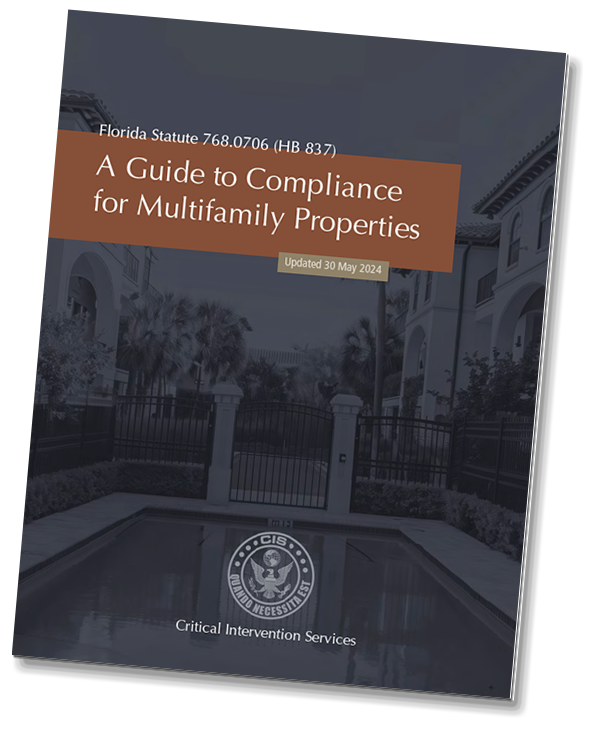
In May 2024, CIS published a comprehensive online guide to assist property owners in developing an informed strategy for compliance with Florida Statute 768.0706.

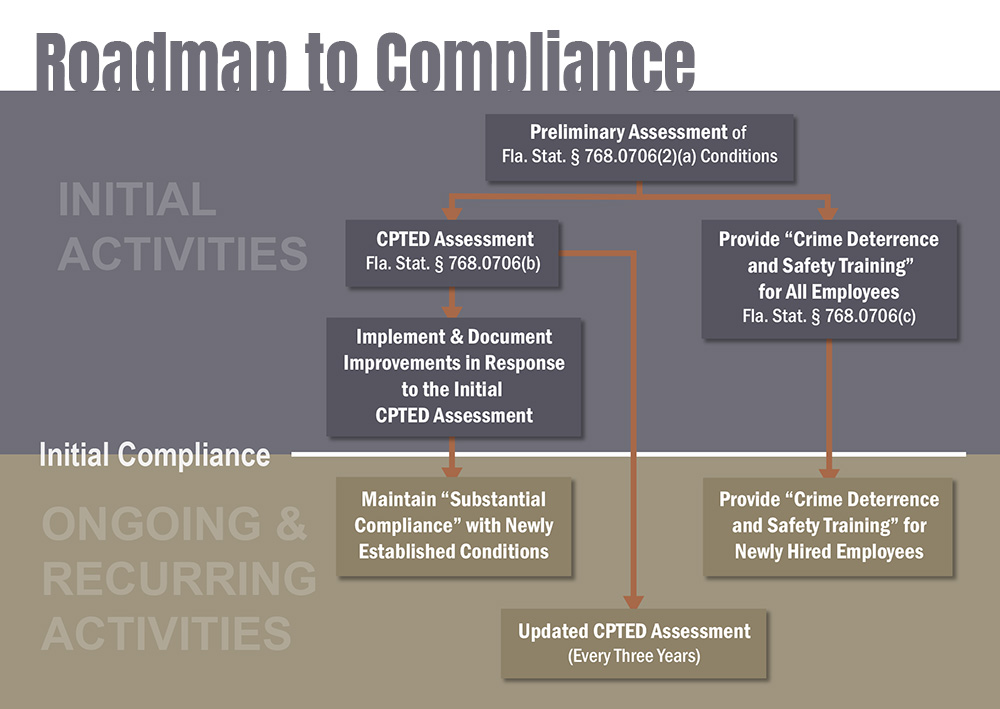
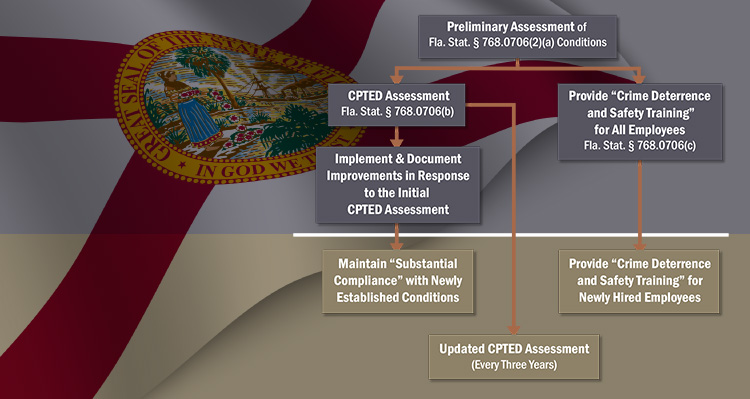
The new guide presents a complete roadmap to compliance beginning with cost-benefit analysis and initial considerations, conducting a preliminary compliance assessment, CPTED assessment, implementation and documentation of improvements, “proper crime deterrence and safety training” for employees, and maintaining ongoing compliance moving forward.

The new guide also explores a number of ambiguities in the statute, strategies for demonstrating “substantial compliance” as required by the law, and approaches for reinforcing defensibility against future court challenge.

Click here to view the web version.

Click here to download the PDF version.

FacilitiesNet Interviews Craig Gundry on Active Shooter Drills and Facility Preparedness

FacilitiesNet Interviews Craig Gundry on Active Shooter Drills and Facility Preparedness

In March 2024, Dan Hounsell, senior editor for FacilitiesNet, interviewed CIS security consultant Craig Gundry, PSP, cATO, for an article examining how facility managers should plan and conduct active shooter drills and training. The resulting article, “Strategies for Successful Active Shooter Drills,” was published in FacilitiesNet’s Emergency Preparedness section alongside commentary from Brendan King of Crisis Consultant Group. FacilitiesNet, published by Trade Press Media Group, is one of the most widely read online resources for facility management professionals and the publisher of Building Operating Management and Facility Maintenance Decisions.

Although most facility managers have no formal training in security, they frequently find themselves at the center of their organizations’ preparations for violence. As Craig noted in the interview, facility managers typically lead on matters related to the physical preparation of facilities — ensuring that effective infrastructure is in place to support response during a life-threatening situation — and frequently carry responsibility for the training component as well, depending on how each organization is structured.

Much of the discussion focused on a question CIS consultants encounter regularly in our assessment and training work: how often should organizations conduct active shooter training and drills? There is no established standard for commercial and workplace settings. Craig’s recommendation in the article was annual training as a minimum, noting that proactive organizations often exceed it — schools, for instance, typically conduct drills anywhere from four times per year to monthly. Organizations with complex operations may warrant greater frequency. Hospitals are a good example: the majority of people present in a healthcare facility at any moment are patients and visitors whose response during an emergency depends on the supervision of employees, which places a heavier training burden on staff.

The interview also addressed a misconception CIS encounters frequently among organizational leadership — the fear that active shooter training will traumatize employees. In our experience, this concern rarely survives contact with an actual training session. As Craig explained in the article, employees who receive this training for the first time do not react with heightened fear; they typically come forward afterward thankful that their employer is being diligent in preparing them to act in their own workspace.

A final topic explored in the discussion was emergency communications — a deficiency our consultants identify in many of the facilities we assess. Systems used for communicating emergencies must be reliable under high-stress conditions with good audibility throughout the facility. Some organizations have attempted to compensate for deficient public address infrastructure with phone- and email-based electronic mass notification systems. These systems are valuable, but only as redundant notification measures — never as the primary means of alerting building occupants during an attack, when every second of warning influences survival.

Read Dan Hounsell’s full article, “Strategies for Successful Active Shooter Drills,” at FacilitiesNet.com. For more on the issues discussed in the interview, see our active shooter response training for employee groups and Craig’s article on important tips for preparing employees through active shooter response training.

CIS consultants assist organizations worldwide in assessing facility readiness for active shooter violence. Contact us using the form below or by calling +1 (800) 247-6055 to discuss your facility.

Contact Us 

Contact us to discuss your unique needs by calling Tel. +01 (727) 461-9417 or by completing the following form:
Craig

CIS: Elevating HB 837 Compliance and Reporting Standards in Florida

CIS: Elevating HB 837 Compliance and Reporting Standards in Florida

TAMPA, Fla., March 12, 2024 /PRNewswire/ — In a landscape where safety and compliance are more critical than ever, Critical Intervention Services (CIS) stands out not only as a leader but also as the largest HB 837 compliance consulting firm in Florida. With a steadfast commitment to mitigating risk, CIS delivers on this promise through a blend of unmatched expertise, a comprehensive approach to security and legal compliance, and a dedication to excellence that spans over three decades. Specializing in multi-family housing security, CIS has made its mark by working in thousands of communities, offering unparalleled protection and strategic advantages to property owners and operators throughout the state.

The enactment of Florida House Bill 837 (HB 837) in March 2023 has introduced new benchmarks for apartment and multifamily property owners, mandating stringent crime prevention measures. CIS leverages its unparalleled expertise and the largest team of specialized consultants in the state to ensure that compliance extends beyond mere adherence to standards. “We solidify our clients’ liability protections by meticulously preparing their certifications to meet HB 837 requirements,” emphasizes the service’s anticipatory nature, designed to meet and surpass the needs and challenges of compliance and legal defense.

“Our philosophy, ‘Discover the Critical Difference,’ is woven into every aspect of our work,” said KC Poulin, CEO & President of CIS. “This means not just achieving compliance but crafting a strategic shield that protects properties against both crime and future legal challenges. Our extensive experience and proactive approach ensure our clients’ peace of mind, knowing they’re fortified against potential risks.” CIS’s strategic foresight in preparing reports and certifications, designed to withstand legal scrutiny, sets a new industry standard. This attention to detail and preparation underscores the critical difference CIS brings to its clients, offering an unmatched level of protection and assurance.

For property owners and operators seeking to navigate the complexities of HB 837 with confidence, CIS’s proven track record and the promise of discovering the critical difference make it the go-to consulting firm in Florida. Detailed information on how Critical Intervention Services can support your community in leveraging HB 837 for enhanced safety and legal protection is available on our resource page: CIS HB 837 Assessment and Crime Prevention.

About Critical Intervention Services (CIS)

For over 30 years, Critical Intervention Services (CIS) has been at the forefront of security and safety consulting for multi-family housing environments. As the largest HB 837 compliance consulting firm in Florida, CIS boasts an unparalleled team of specialized consultants, offering in-depth solutions for property owners and operators aiming to enhance their safety and legal protection.

Free Webinar on HB 837 for Multifamily Property Owners

Residential Community Crime Prevention

Free Webinar on HB 837 for Multifamily Property Owners

Florida House Bill 837 (HB 837) was signed into law in March 2023, offering strong liability protections for apartment and multifamily property owners who implement specific crime prevention measures as defined by new statutes. These measures include ensuring the presence of physical security conditions defined in F.S. 768.0706(2), having a documented CPTED assessment conducted by a law enforcement agency or a Florida Crime Prevention Through Environmental Design Practitioner (FCP), and training employees in crime deterrence and safety measures beginning in January 2025.

While the requirements of HB 837 may seem straightforward, there are a number of issues that warrant informed consideration and rushing to comply can inadvertently create new liability conditions.

On July 25, 2023, CIS is hosted a free webinar exploring the requirements of HB 837 and presenting a strategy for compliance that considers future developments and enhances defensibility against potential court challenges.

Click the play button to view the video.

Play Video

Fox News Interviews CIS about Armed School Employees

Armed Teachers in Schools

Fox News Interviews CIS about Armed School Employees

On May 2, 2023, Fox News Channel published a story featuring an interview with CIS VP of Special Projects, Craig Gundry, discussing armed teachers as a protective strategy in schools.

https://www.foxnews.com/us/school-districts-across-america-consider-arming-teachers-aftermath-nashville-school-shooting

Unfortunately, some of the most valuable points we discussed in that interview were omitted from final publication.

As a first point, arming teachers is not a reliable strategy for response to active shooter attacks. As one source of support for this perspective, a team of researchers at Purdue University evaluated armed school employees during an analysis of alternative response models and concluded that employees carrying concealed weapons were far less effective than a school resource officer and performed only marginally better than police dispatched in response to 911 calls.[1]

Our position on this topic is clear. If schools wish to authorize teachers to carry concealed weapons, armed school employees should only be regarded as an additional readiness measure to supplement the existing presence of a professional armed responder (SRO or properly-trained armed security officer). And if schools decide to allow employees to carry firearms, they should approach this idea in a manner that is responsible, effective, and defensible from a liability perspective.

As a starting point, measures should be implemented to ensure that armed school employees are properly trained in safe firearms handling and marksmanship skills. There’s a major difference between shooting at paper targets on a firearms range and engaging a moving aggressor in an environment dense with students. To address this matter, states such as Virginia and Florida mandate specialized training and certification for security officers and school employees assigned in armed capacities.[2][3] However, many schools and districts adopting this measure overlook the importance of training standards.

Next, policies and procedures should be developed regarding approved methods of concealed carry and firearm storage and approved weapons and ammunition. Likewise, the role of armed teachers in responding to shooting events should be clearly defined so there is no implied expectation that an armed teacher is expected to seek out and neutralize a gunman. In other words, teachers are permitted to be armed for the protection of themselves and students in their immediate presence with no further expectations.   

For more information about this topic, see the video below. Our perspective about arming school employees can be found at 1:57:43.

Play Video

[1] Anklam, C., Kirby, A., Sharevski, P., & Dietz, J. “Mitigating Active Shooter Impact: Analysis for Policy Options Based on Agent/computer-based Modeling.” Journal of Emergency Management 13.3: 201-16, 2014.

[2] United States. State of Virginia. Administrative Code, Chapter 240. Regulations Relating to School Security Officers.

[3] United States. State of Florida. Chapter 30.15. Sheriffs – Powers, duties, and obligations.