
CIS Presents CPTED for Multifamily Properties in HAI Group Security Webinar
On July 15, 2025, Craig S. Gundry, PSP, cATO, FCP, of Critical Intervention Services delivered a 40-minute presentation on Crime Prevention Through Environmental Design (CPTED) for multifamily properties as part of HAI Group’s webinar, “Strengthening Security in Multifamily Housing: Strategies and Success Stories.” The free webinar paired CIS’s presentation on CPTED principles with a case study on the West Palm Beach Housing Authority’s security initiative, presented by Leon Lipsick, followed by live Q&A with attendees.
HAI Group is a member-owned insurance organization founded by public housing authorities nearly four decades ago and today serves as a leading provider of property and casualty insurance to the public and affordable housing industry nationwide. The webinar was inspired by the release of HAI Group’s Housing Security and Law Enforcement Operations Guide, a free resource offering guidance on crime prevention, building community trust, and strengthening partnerships with law enforcement.
Craig’s presentation introduced CPTED as a multi-disciplinary approach to crime prevention that uses urban and architectural design and the management of built and natural environments to reduce victimization, deter offender decisions that precede criminal acts, and build territorial control among residents. The program was organized around the four key CPTED principles — natural surveillance, natural access control, territorial reinforcement, and maintenance — with extensive field photography from CIS assessments illustrating each concept as it appears on real multifamily properties.
Much of the presentation addressed natural surveillance and its two most common adversaries in multifamily environments: obstructive vegetation and deficient lighting. Using nighttime assessment photography with documented light meter readings, Craig illustrated the full range of lighting problems CIS routinely documents during property assessments — obstructed luminaires, inadequate luminous flux, absent and inoperative lights, glare conditions, and excessive contrast ratios — alongside examples of properties with well-executed lighting. The presentation referenced illumination and contrast ratio criteria from the Illuminating Engineering Society’s Guide for Security Lighting for People, Property, and Critical Infrastructure (2016), the authoritative reference CIS uses when evaluating lighting during CPTED assessments.
The program also examined offender concealment opportunities created by structural design, natural access control through landscaping and terrain barriers, and territorial reinforcement measures including celebrated entryways, wayfinding signage, transition zones, and restrictive signage — with a caution for property operators to be conscious of signage language that contributes to a false expectation of security. The presentation concluded with a review of maintenance conditions and physical disorder, followed by a summary of Florida Statute 768.0706 and its three categories of compliance requirements: the seven physical security measures defined in 768.0706(2)(a), the CPTED assessment requirement, and mandatory crime deterrence and safety training for employees.
Insurance carriers and risk advisors have become one of the most consistent drivers of security improvement in the multifamily sector, and programs like this one reflect the growing recognition that environmental design is among the most cost-effective tools available for reducing crime risk on residential properties. CIS thanks HAI Group for the invitation and the West Palm Beach Housing Authority for sharing its experience putting these principles into practice.
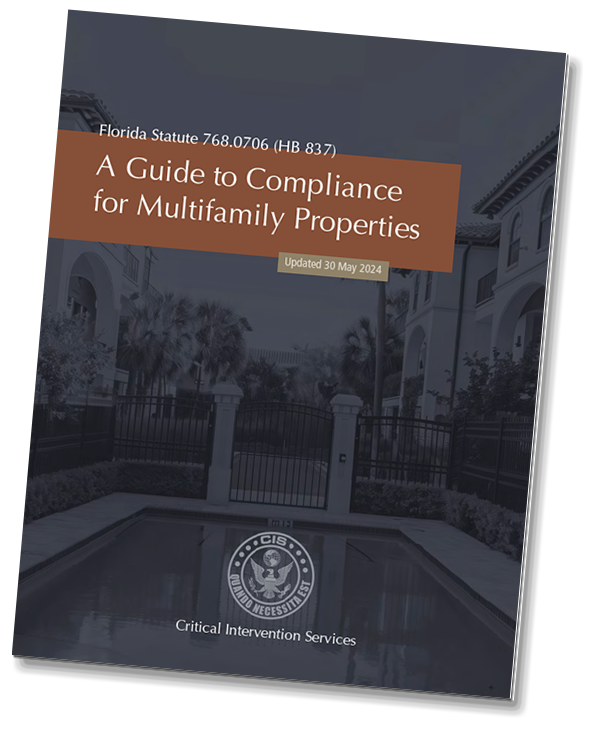
For property owners and operators interested in CPTED assessment services or Florida Statute 768.0706 compliance, see our compliance guide and CPTED services page.
Contact Us
Contact us for a free consultation about Fla. Stat. § 768.0706 compliance by calling Tel. +01 (727) 461-9417 or by completing the following form: