
CIS Presents CPTED and Fla. Stat. 768.0706 Program at ASIS West Florida Chapter Luncheon
On September 18, 2025, Craig S. Gundry, PSP, FCP, Senior Partner and Chief Security Strategist at Critical Intervention Services, presented a program on Crime Prevention Through Environmental Design (CPTED) and Florida Statute 768.0706 during a luncheon meeting of the ASIS International West Florida Chapter. The program was attended by approximately two dozen security professionals from the Tampa Bay region representing corporate security, consulting, and law enforcement backgrounds.
ASIS International is the world’s largest association for security management professionals and the certifying body for the CPP, PSP, PCI, and APP designations. The West Florida Chapter serves practitioners throughout the Tampa Bay area, and its meetings provide a forum for continuing education on developments affecting the profession — a fitting audience for a statute that has created an entirely new category of assessment work for Florida security practitioners.
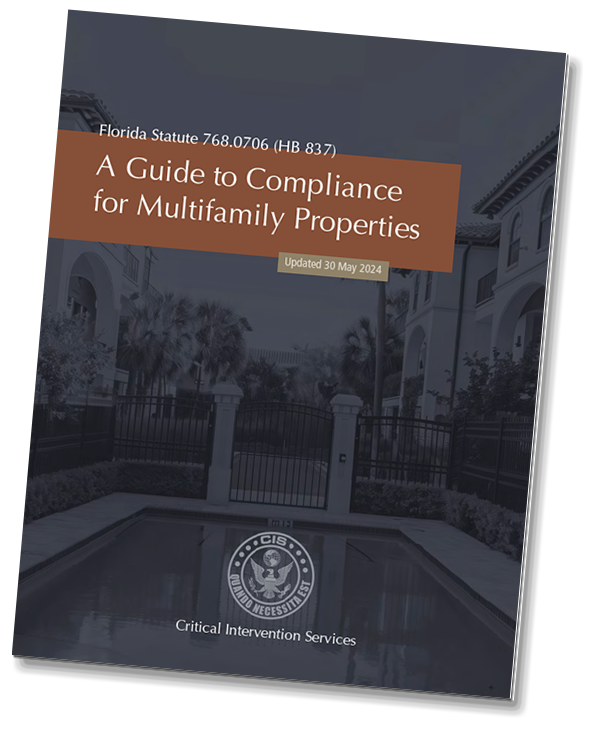
The presentation opened with an overview of F.S. 768.0706 and the presumption against liability it provides to multifamily property owners and operators who substantially implement its requirements: the seven physical security measures enumerated in 768.0706(2)(a), a CPTED assessment performed within the previous three years by a law enforcement agency or a Florida CPTED Practitioner (FCP), and proper crime deterrence and safety training for all employees, with new employees trained within 60 days of hire.
Because the audience consisted of working security professionals rather than property operators, a significant portion of the program addressed the statute’s unresolved interpretive questions and the positions CIS has adopted for verifying compliance in our assessment practice. These include the undefined scope of “points of entry and exit” for camera coverage — which CIS interprets as all designed entrances through the legal boundary separating exterior public space from the private property — along with the statute’s unusual 1.8 foot-candle at 18-inch parking lot measurement standard, the ambiguous meaning of “porches” in the common-area lighting requirement (which CIS interprets to include breezeways and exterior apartment entrances, but not porches inside leased private living spaces), and the question of what proximity of a light source satisfies the statute’s “lighting in” language. With no case law yet interpreting these provisions, documented and defensible interpretive positions are essential for any practitioner conducting assessments under the statute.
The balance of the program covered CPTED principles as applied to multifamily properties — natural surveillance, natural access control, territorial reinforcement, and maintenance — illustrated with field photography and light meter data from CIS assessments across Florida. Examples included obstructive vegetation conditions, offender concealment opportunities created by structural design, the full spectrum of lighting deficiencies documented during nighttime inspections, and territoriality measures ranging from celebrated entryways to restrictive signage, including a caution regarding signage language that creates a false expectation of security.
CIS thanks the ASIS West Florida Chapter and its officers for the invitation and the engaging discussion that followed. Several of our consultants maintain longstanding involvement with ASIS International, and chapter programs like this one remain one of the best venues for advancing professional practice in our region.
Contact Us
Contact us for a free consultation about Fla. Stat. § 768.0706 compliance by calling Tel. +01 (727) 461-9417 or by completing the following form: