
Budgeting for Compliance: What Florida CPTED Assessments Under F.S. 768.0706 Actually Find—and What Corrections Cost

Budgeting for Compliance:  What Florida CPTED Assessments Under F.S. 768.0706 Actually Find—and What Corrections Cost

In July 2023, I authored an article examining what property owners and managers should expect when commissioning a CPTED assessment for compliance with Florida Statute 768.0706. I followed that up in 2024 with a six-part compliance guide examining the entire process from initial cost-benefit analysis through establishing a sustainable compliance management process. Both publications were aimed at answering the big procedural questions—what the statute requires, the assessment process, and how to bolster defense against challenge by plaintiffs. But procedural guidance answers only half of what an owner needs to know before committing to this process. The question we field most frequently—often during our first phone call—is far more practical: What are you likely to find on my property, and what will it cost to fix?

Until recently, my honest answer was anecdotal—informed by years of assessments but never quantified. While preparing for an upcoming conference presentation, I conducted an analysis of 30 sample properties assessed by CIS under F.S. 768.0706 to quantify which compliance deficiencies and CPTED problems appear most frequently during these assessments. I then paired those findings with remediation cost data harvested from actual client project records and from Ecofi, a lighting design firm we’ve worked with on remediation projects for multiple clients. Following are the results, along with practical advice for anticipating improvement costs when budgeting for the compliance process.

A few words about the sample before we proceed. The 30 properties consist of Florida multifamily and senior living communities selected with a type and size distribution representative of the 291 properties we assessed as of the date of the analysis. The set encompasses 26 existing properties and four newly-constructed properties—spanning garden-style, mid-rise, and bungalow-style communities with unit counts ranging from 33 to 528. Urban high-rise buildings were omitted from the dataset to avoid contaminating the analysis, since they tend to have a distinctly different pattern of conditions.

The sample skews heavily toward affordable and tax-credit housing (20 of 30 properties), with four public housing/special program properties and only two market-rate communities, so the averages presented here should not be read as representative of the Florida multifamily market as a whole. Subgroup figures at small sample sizes are directional, not definitive. Withstanding these limitations, the patterns across the sample are consistent enough to support useful budgeting guidance. In total, our assessments documented 1,491 distinct issue instances across the 26 existing properties.

Every Existing Property Failed Something

Let’s begin with the finding that matters most for anyone entering this process with expectations of a clean report: all 26 existing properties in the sample—100%—had at least one deficiency at initial assessment against the security measures enumerated in F.S. 768.0706(2)(a). Not most. All of them. And these were not neglected properties; the sample includes well-managed communities with attentive maintenance staff and recently-renovated sites. Twenty-six of twenty-six is not a statistic that leaves much room for optimism about your property being the exception.

The good news is that a deficiency finding is not a compliance failure—it is the starting point of the compliance process. The statute’s presumption against liability rewards owners who identify deficiencies, remediate them, and document the work. In this respect, the assessment report should be understood as a remediation planning document, and the records generated during correction should be maintained for discovery purposes if a court challenge ever arises. For budgeting purposes, the practical implication is simple: owners should enter the assessment process with a corrective budget line already anticipated, not discover the need for one when the report arrives. The balance of this article is aimed at helping predict what that line item may contain.

The Statutory Compliance Scorecard: What Fails and What Doesn’t

F.S. 768.0706(2)(a) enumerates seven defined security measures for the “premises”: a security camera system at “points of entry and exit” with 30-day video retention, a lighted parking lot maintaining an average of 1.8 foot-candles at 18-inches above the surface, walkway and common-area lighting from “dusk until dawn,” 1-inch deadbolts on dwelling unit doors, locking devices on windows and exterior sliding doors, locked gates with key or fob access at pool fence areas, and peepholes or door viewers on unit doors lacking adjacent windows.

As a starting point, unit-level hardware requirements are rarely the problem. In our sample, non-compliant deadbolt locks appeared at exactly one property out of 26 (3.8%). Non-compliant window locks: also one property (3.8%). And in the latter case, the problem wasn’t missing locks, but rather worn locks that couldn’t function for their intended crime prevention purpose under the statute. Florida’s multifamily housing stock is, as a general matter, already built and maintained to these hardware requirements. Obstructed door viewers appeared somewhat more often (six properties, 23.1%)—typically the result of paint or accumulated dirt—but this is a maintenance-and-policy correction, not a capital expense.

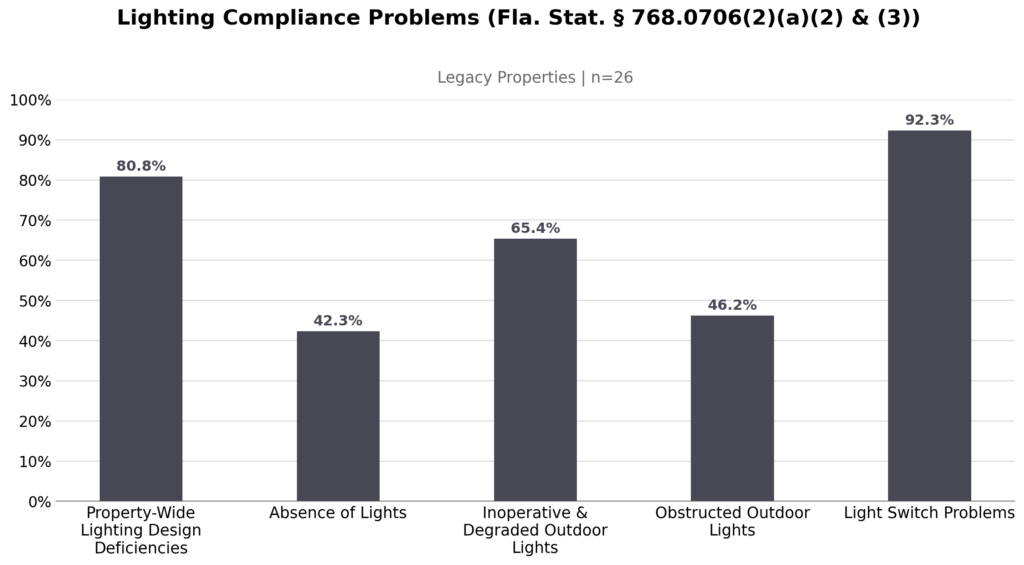
Some of the most frequent problems are unglamorous ones. Light switch problems appeared at 24 of 26 existing properties (92.3%). This finding deserves explanation, because it catches nearly everyone off guard. The statute requires illumination of walkways, laundry rooms, common areas, and porches from “dusk until dawn”—but on property after property, we find that lighting serving these areas is often controlled by unsecured wall switches accessible to residents and the public, or by motion sensors and timers that interrupt illumination during the required period. A light that anyone can switch off is a light that cannot be relied upon to satisfy a “dusk until dawn” requirement, and a plaintiff’s expert will make exactly that argument. Unsecured switches were the third most prevalent individual problem in the entire dataset, appearing at 26 of 30 properties (86.7%) including the new construction. The corrections—locked switch/thermostat boxes or hard-wiring circuits to the electrical panel—are individually inexpensive, but they are ubiquitous.

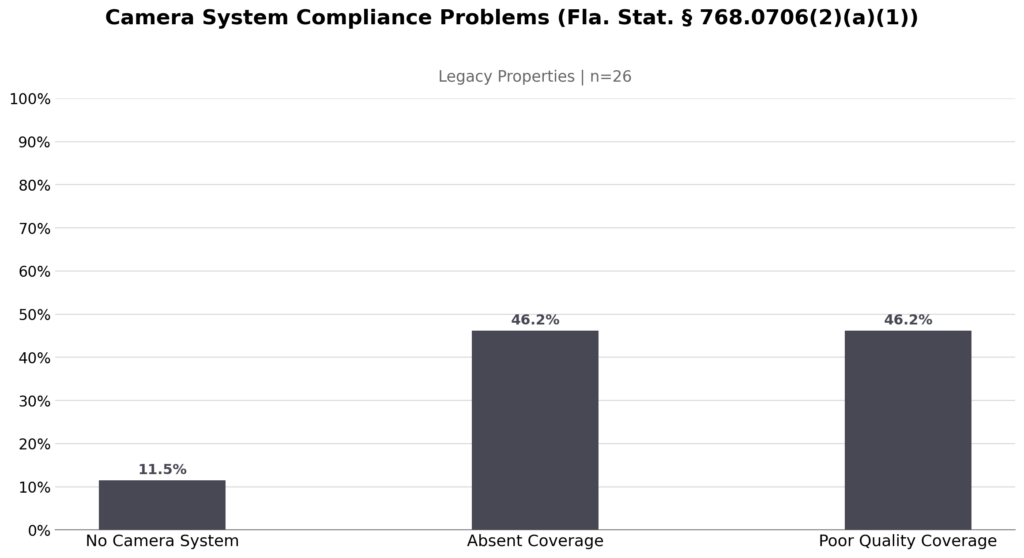
Pool gate deficiencies appeared at half of the existing properties (13 of 26)—unsecured gates, child safety locks unlocked and unattended during daytime hours, and broken latches. And camera system deficiencies were nearly as widespread: 20 of 26 existing properties (76.9%) had at least one camera-related finding. Only three properties (11.5%) lacked a camera system entirely, but 12 properties (46.2%) had absent coverage at one or more “points of entry and exit,” and an equal number had coverage of such poor quality—aged cameras, connectivity problems, inadequate resolution at the distances involved—that it could not reasonably serve the statute’s evident purpose. Simply put, most properties have cameras; far fewer have the type and quality of coverage expected under the statute.

Lighting: The Big Ticket Item

If the statutory scorecard identifies what fails most often, the lighting category identifies where the money goes. Among the 23 existing properties with open parking lots, 20 (87%) measured below the statutory 1.8 foot-candle average, and 22 (95.7%) fell below the Illuminating Engineering Society’s recommended practices for the relevant applications. More significantly for budgeting purposes, 21 of 26 existing properties (80.8%) exhibited property-wide lighting deficiencies serious enough to require an engineered redesign of the outdoor lighting system—not spot repairs, but photometric analysis, new fixture schedules, and in many cases new poles and circuits. Add the accumulated fixture-repair backlog we typically document (279 individual fixture-level deficiencies across the sample: inoperative pole lights, degraded wall packs, dark breezeways, fixtures obstructed by tree growth) and lighting emerges, by a wide margin, as the dominant capital item in HB 837 remediation.

So what does correction cost? For this question, we turned to Ecofi, a lighting design firm we’ve worked with on remediation projects for multiple clients, who generously shared cost data from their project records. Across 181 analyzed lighting improvement projects serving 32,663 total units, project costs ranged from $10,000 to $100,000, with an average final contract value of $52,656—approximately $321 per unit. That per-unit figure is the single most useful budgeting heuristic in this article. An owner of a 250-unit garden community facing a property-wide lighting finding can reasonably anticipate a project on the order of $80,000; a 100-unit property, roughly $32,000. Actual costs will vary with site conditions, but Ecofi’s per-unit average provides a good metric for preliminary budgeting.

Ecofi’s data also reveals a pattern worth attention when anticipating your own exposure: average project cost varies substantially by the property’s year of construction. Remediation costs peak for properties built between roughly the mid-1980s and mid-2000s, where the trend line runs near $70,000-$73,000 per project, remain moderate for older stock, and decline steeply for post-2010 construction, falling toward $30,000. Older fixture technology is one type of contributing factor. Spacing between lights in relation to their luminous flux (light output) is another. This combination of problems is often easily diagnosed after our field assessment when analyzing spreadsheet data of our light measurements: on older properties, it is common to find fewer than 10% of meter readings meeting statutory or IES guidelines, with extended rows of measurements catalogued at 0.0 fc (dark enough that the light meter rounded down to zero).

The following chart provides a summary of compliance problems related to lighting in our dataset.
Camera Systems: The Widest Cost Variance

Camera remediation displays the widest cost variance of any category in our client records: actual corrective projects ranged from $2,000 to $50,000. The variance reflects the difference between filling coverage gaps and replacing systems. A property with a functioning modern system that simply lacks coverage at one “point of entry or exit” faces a modest project; a property with an obsolete analog system, or none at all, faces a full design-and-installation effort at the top of the range.

But even within gap-filling projects, site conditions drive order-of-magnitude differences. A simple camera installation mounted to a clubhouse—existing structure, available power, short cable run—may cost less than $1,000. A single camera covering an entry drive hundreds of feet from the nearest building may require a new pole, trenching to lay cable, or point-to-point wireless transmission hardware, pushing that one camera position to several thousand dollars. The lesson for budgeting is that camera costs are estimated per position and per pathway, not per device—the camera itself is frequently the cheapest component of the installation. For this reason, owners should treat any camera deficiency finding as a request for a site-specific quote rather than attempting to budget from equipment prices.

Following is a chart summarizing our findings regarding camera deficiencies identified in the dataset.
Landscaping, Maintenance, and Management Practices: Ubiquitous but Inexpensive

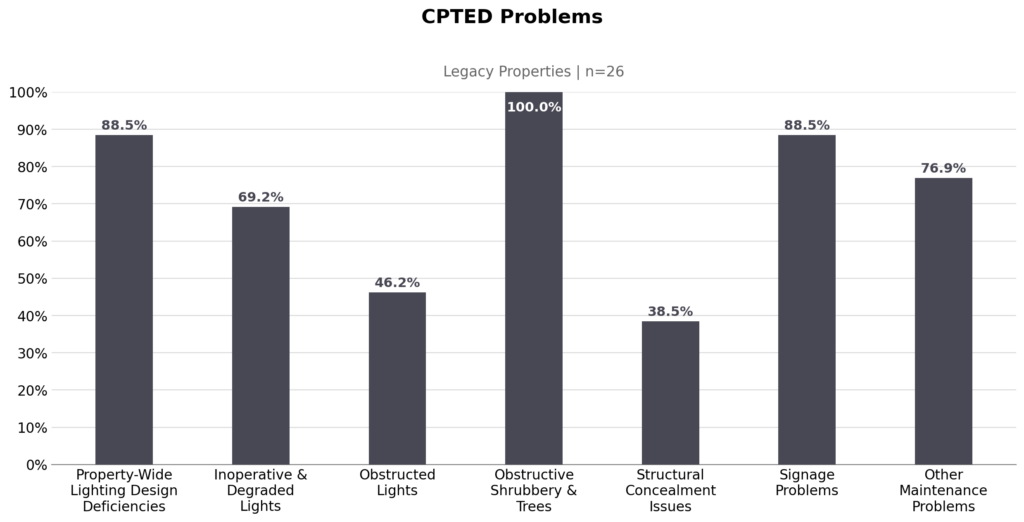
Here is the finding that dominates the raw numbers while barely denting the budget: landscaping and sightline problems appeared at every one of the 26 existing properties and accounted for 797 issue instances—more than half (53.5%) of every deficiency we documented in the entire study. Tall shrubbery obstructing natural surveillance was the second most prevalent individual problem in the dataset, appearing at 28 of 30 properties (93.3%) with 648 documented instances. Low tree canopies appeared at 60% of properties, and trees obstructing light fixtures—a problem that converts a landscaping maintenance issue into a lighting problem—at 40%.

The good news is that this most ubiquitous category is also the least expensive to correct. Landscaping alterations and tree pruning projects in our client records ranged from $1,000 to $7,000. The higher end of that cost spectrum encompassed larger properties and situations where existing plant species required replacement.

And unlike lighting or camera systems, landscaping correction is almost entirely preventable going forward at negligible cost. Which brings us to the most prevalent single finding in the entire study: at all 30 properties—100%, including the newly-constructed ones—the landscaping maintenance contract contained no specifications for maintaining shrubbery and trees according to CPTED guidelines. Groundskeepers were maintaining plant health and curb appeal because that is what their contracts asked of them. Nobody had asked them to maintain sightlines. Our consultants recommend that every property owner subject to F.S. 768.0706 revise their landscaping contract to include CPTED maintenance specifications—shrub height limits, canopy clearances, and fixture clearance requirements—so that a one-time corrective pruning project does not silently regrow into next year’s deficiency finding. A related management gap appeared at 30% of properties: no policy for documented inspection of security-relevant conditions (lighting outages, gate hardware, camera function) on a scheduled basis.

The same logic extends beyond vegetation to the property’s broader image and maintenance conditions. Signage problems appeared at 23 of 26 existing properties (88.5%), accounting for 56 issue instances—most commonly faded and sun-bleached signs (65.4% of properties), followed by missing no-trespassing signage (34.6%) and missing entrance identification (26.9%). General site maintenance findings appeared at 19 of 26 properties (73.1%): ground litter (53.8%), graffiti (23.1%), damaged site equipment, and abandoned objects. And damaged perimeter fencing appeared at 34.6% of properties, with another 11.5% exhibiting fencing compromised by vegetation growth. Individually, none of these findings carries a meaningful price tag—sign replacement, litter policing, and fence repair are maintenance-budget items, not capital projects. But collectively they matter more than their costs suggest. In CPTED terms, these are image-and-maintenance deficiencies: conditions that signal to prospective offenders how closely a property is supervised, and faded signage communicates much the same message as an unsecured gate.

Following is a summary of our findings regarding CPTED matters outside the purview of statutory compliance.
New Construction: Cleaner, Not Perfect

CIS provided plan review and specifications during the design process for two out of the four newly constructed properties in the dataset. The other two were constructed with statutory compliance as an objective, but without our direct input or guidance.

None of the four measured below the statutory parking-lot lighting standard—modern photometric design earns its keep—and their overall issue intensity was dramatically lower, averaging roughly 8-21 instances per 100 units against a 33-instance average for existing properties. But all four had light switch problems, two of four fell below IES lighting guidelines, and one had absent camera coverage at a “point of entry or exit.”

Three of the four had instances of obstructive shrubbery, but at far lower intensity than the legacy properties—legacy: 12.5 instances per 100 units; new construction: 2.6 (pooled).

Putting the Budget Together

So what should an owner entering this process actually anticipate? Issue intensity in our sample averaged 33 instances per 100 units across existing properties, but varied predictably by property character: mid-rise properties averaged about 25 instances per 100 units, garden communities about 36, and bungalow-style properties about 43—sprawling low-rise sites simply present more lighting, landscaping, and perimeter surface area per unit. By leasing category, market-rate properties averaged about 14 instances per 100 units, affordable/tax-credit properties about 31, and public housing about 51, though the market-rate and public-housing figures rest on small subsamples and should be treated as directional.

For the corrective budget itself, the data supports a three-tier expectation. First, near-certain and inexpensive: landscaping alterations ($1,000-$7,000), switch security corrections, signage replacement, and a revised landscaping contract—corrections nearly every property will need and most can absorb within existing maintenance budgets. Second, probable and variable: camera system corrections ($2,000-$50,000 observed range), where roughly three-quarters of existing properties had findings and cost depends entirely on site conditions and system age. Third, probable and capital-scale: lighting improvements ($10,000-$100,000 observed range, $52,656 average, roughly $321 per unit), where four out of five existing properties required engineered redesign. An owner who budgets against the per-unit lighting heuristic, obtains site-specific camera quotes, and folds the landscaping corrections into routine maintenance will rarely be surprised by the remediation phase of this process.

For owners beginning this process, CIS provides CPTED assessments for F.S. 768.0706 compliance conducted by our team of Florida CPTED Practitioners, along with remediation planning support and reassessment services under extended agreements. But whoever conducts your assessment, the arithmetic in this article points to one conclusion: the owners who struggle with compliance are rarely the ones with the worst deficiencies. They’re the ones who budgeted for none.


What to expect from an HB 837 CPTED Assessment?

What to expect from an HB 837 CPTED Assessment?

Since HB 837 was signed into law in March 2023, many apartment owners and property management companies throughout the State of Florida have awakened to the powerful liability protections provided by the new statutes. Just in the past month, our firm has spoken with a half dozen companies eager to get started as soon as possible.

While many seem to have a sense of where they stand regarding most measures described in F.S. 768.0706(2)(a), few arrive with an understanding of what is encompassed during a Crime Prevention Through Environmental Design (CPTED) assessment and the types of issues they may be expected to address while improving their properties for compliance.

The following article is written to provide an understanding of the assessment process, common CPTED guidelines that will likely influence the observations of the Florida CPTED Practitioner, and some specific nuances regarding HB 837 that should be considered when initiating assessments.

Verification of F.S. 768.0706(2)(a) Compliance versus CPTED Assessment

As a preliminary point, there is a difference between compliance with F.S. 768.0706(2)(a) and compliance with common guidelines in CPTED. Some property owners we’ve spoken with believed that if they were compliant with the seven defined measures in F.S. 768.0706(2)(a) (e.g., 1-inch deadbolt throws, peepholes, pool access, etc.), they would naturally be compliant with CPTED guidelines as well. That’s a false assumption.  

With the exception of lighting, there are few measures in F.S. 768.0706(2)(a) that directly correspond with CPTED practices. And even on the subject of lighting, there are important differences that property owners should be aware of.

When approaching a Florida CPTED Practitioner (FCP) for an assessment, it’s important to clarify the scope as related to the measures defined in F.S. 768.0706(2)(a). The statute only states: “By January 1, 2025, the owner or principal operator of a multifamily residential property has a crime prevention through environmental design assessment that is no more than 3 years old completed for the property.” It does not state that the documented CPTED assessment must also encompass the seven measures stated in F.S. 768.0706(2)(a).

However, most clients we have spoken with want both—a CPTED assessment that meets the requirements of F.S. 768.0706(2)(b) and a written document verifying their compliance with the measures in F.S. 768.0706(2)(a). From a practical perspective as a scope of work, verifying compliance with F.S. 768.0706(2)(a) as an additional activity is largely a matter of some extra work time. However, there is one topic where the difference is important.

During CPTED assessments, illumination in parking lots is normally measured at surface level and 5-feet vertical from surface in accordance with guidelines by the Illuminating Engineering Society (IES). However, to verify compliance with HB 837, illumination in parking lots needs to be measured at 18-inches from ground. Although this may sound like a minor technical matter, the cost of work time for measuring and documenting illumination levels at both heights would result in double the normal price for a parking lot lighting assessment. As a result, if HB 837 verification is part of the scope, most Florida CPTED Practitioners will choose to approach the parking lot lighting assessment using the HB 837 requirement rather than standard IES guidelines.

The HB 837 CPTED Assessment Process

Following is a description of how a typical CPTED assessment of a multifamily property would be conducted, including in this example verification of HB 837 compliance.

As a preceding matter, the Florida CPTED Practitioner should retrieve a crime report for the property and surrounding area to identify any unique conditions warranting special consideration during the on-site assessment. In alignment with practices promoted by the Florida Crime Prevention Training Institute (FCPTI), the crime analysis should encompass current statistics in addition to a 5-year historical trends analysis.

The on-site assessment typically commences with a meeting with the property manager to review background information about the property and identify any unique concerns. After the manager interview, the CCTV system is evaluated for compliance with requirements defined in F.S. 768.0706(2)(a)(1). Although we normally prefer to evaluate CCTV under nighttime conditions during our comprehensive property inspections, daytime CCTV assessment is more convenient for property managers if the main objective is to only verify compliance with HB 837’s coverage requirements.

Afterward, a physical inspection of the property is conducted to evaluate CPTED conditions and compliance with requirements defined in F.S. 768.0706(2)(a). Some of these compliance verification activities should include inspection of the pool area and residential units for conditions as required under F.S. 768.0706(2)(a).

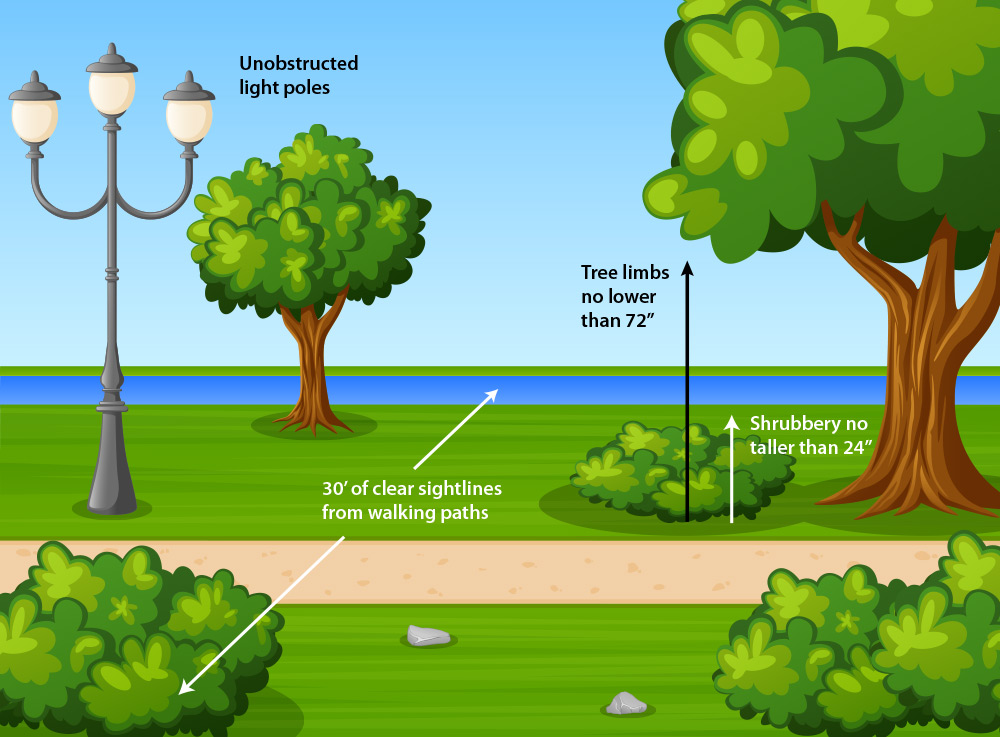
A major focus of CPTED surveys in multifamily properties is landscaping design and its influence on “natural surveillance”—ensuring unobstructed sightlines throughout the property to reduce offender concealment opportunities and facilitate observation of criminal activity. For this purpose, FCPTI promotes the ‘2ft-6ft rule’ whereby all hedges and bushes should be no taller than 24” in height and tree limbs should be no lower than 72” from the ground. As a property owner, expect that any shrubbery and trees that deviate from this guide will appear in the report.

The Illuminating Engineering Society also promotes a similar guideline (3ft-7ft rule), but most Florida CPTED Practitioners use the 2ft-6ft rule when doing assessments to ensure best conformity with guidelines promoted by the Florida Crime Prevention Training Institute (FCPTI).

In addition to the 2ft-6ft rule, CPTED guidelines promoted by FCPTI also include the 30-ft sightline rule. Under the 30-ft sightline rule, there should be 30 feet of unobstructed sightlines along the sides of all sidewalks and walking paths.

In addition to maintaining clear sightlines, all trees located near light poles should be trimmed in a manner that luminaires are unobstructed and branches don’t cast shadows below.

HB 837 CPTED assessment - Landscaping Issues

Following are some examples of trees and shrubs that would be documented unfavorably in a CPTED assessment report.

In addition to landscaping issues, the property features and buildings are examined for possible offender concealment opportunities with special focus on common areas and pedestrian walkways. Below are some examples of offender concealment opportunities that would likely be documented in a CPTED assessment report.

Other issues encompassed during daytime assessments often include signage and “wayfinding measures, territorial definition, natural access control, and property maintenance.

After dusk, the assessment continues with a lighting assessment. If HB 837 verification is part of the scope, the Florida CPTED Practitioner will likely approach the parking lot independently by measuring illumination levels metered at 18-inches from ground surface (as required for establishing compliance with F.S. 768.0706(2)(a)(2)). Some CPTED practitioners grid parking lots for assessment. Others, such as CIS, prefer to meter each parking space independently when establishing an average illumination level for the highest degree of comprehensiveness and accuracy.

After the parking lot lighting survey is complete, the lighting assessment continues with focus on sidewalks, building entrances, mailboxes, and outdoor activity areas. In following with FCPTI guidelines, illumination levels in these areas are metered according to criteria established by the Illuminating Engineering Society (IES) and recorded. If HB 837 compliance is part of the scope, the Florida CPTED Practitioner would also be verifying the presence of lighting in walkways, laundry rooms, common areas, and “porches” as required by F.S. 768.0706(2)(a)(3).

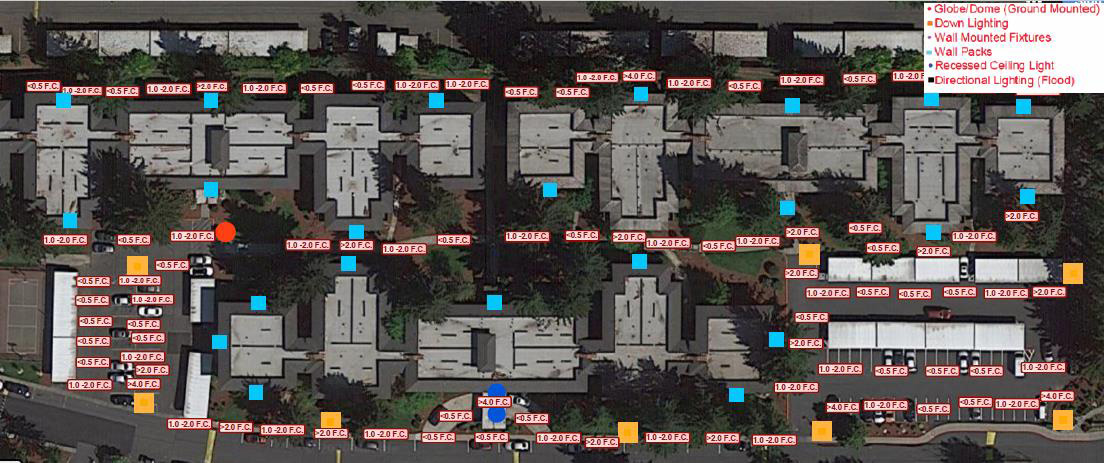
When the final report is delivered, a lighting map should be included identifying illumination levels in locations throughout the property and additional observations regarding contrast ratio, glare, light trespass, and maintenance issues such as degraded and burned out lights.

Legal Defensibility, HB 837, and Assessment Reports

Although HB 837 provides robust protection to property owners against frivolous lawsuits resulting from criminal activity, it is naturally expected that plaintiff attorneys will attempt to undermine HB 837’s liability shield by claiming that the defendant’s properties are non-compliant with requirements of the statutes. And one possible angle for establishing the appearance of non-compliance is discrediting the CPTED assessment performed by the Florida CPTED Practitioner and methods used for verifying and documenting compliance during the inspection.

As a starting point, property owners should ensure that the Florida CPTED Practitioner is conducting the assessment and making observations in close alignment with guidelines and practices promoted by the Florida Crime Prevention Training Institute (FCPTI). Although FCPTI is not directed under the statute to establish standards for assessments, the Florida Crime Prevention Training Institute (FCPTI) is directly referenced twice in the statute and will naturally be cited as an authority for standard of care by experts in legal proceedings.

When selecting a Florida CPTED Practitioner as a consultant, it is highly recommended that property owners view an example of the consultant’s written work product to examine the practitioner’s attention to defensibility in court. Following are some questions to consider when evaluating prospective consultants and examining their CPTED reports:

    • Does the Florida CPTED Practitioner have experience with premises liability cases? Better yet, do they have courtroom experience as an expert witness? Assume that the practitioner’s CPTED report will be challenged and if so, it’s very likely the consultant will be called to testify.
    • Is the light meter used by the consultant calibrated and NIST-certified for accuracy? If not, this opens an opportunity for discredit by an opposing Plaintiff’s expert.
    • Is the report accompanied by appendixes or footnotes defining the CPTED standards and authoritative sources as basis for his/her observations?
    • How does the Florida CPTED Practitioner address property features that cannot be changed without major redesign of the site or reconstruction of buildings? Be aware that some measures encompassed under CPTED doctrine relate to the original property design and cannot be reasonably addressed without very major expense. However, omitting the presence of these types of conditions in a CPTED report provides an angle of opportunity for an opposing expert seeking to discredit the assessment (i.e., “Respectfully, the assessment is incomplete, counselor.”). How does the consultant address this type of situation in their reports to ensure comprehensiveness while also managing foreseeability?
    • What is the “quality” of the report documentation? Although they say “Justice is blind,” appearance does matter in the eyes of judges and juries. How well written is the report regarding format & organization, clarity, articulation with attention to potential court interpretation, grammar, and aesthetic design?
Facebook
Twitter
LinkedIn
Email

Securing Residential Communities: Comprehensive Strategies for Stakeholders

Residential Community Crime Prevention

Securing Residential Communities: Comprehensive Strategies for Stakeholders

In every jurisdiction, communities across the United States are susceptible to individuals with malicious intent. It is crucial for stakeholders to remain vigilant in identifying criminal activities and the individuals involved. However, the impact of these criminal activities often affects the community more than the individuals perpetrating the crimes. Therefore, addressing criminal activity promptly upon discovery should be the top priority for housing operators as it provides the best defense against recurring incidents. Long-term criminal issues typically arise from a failure to identify crime and implement effective mitigation strategies when crimes occur within or near the community or property.

Challenges and Strategies

The management of drug use incidents, gun-related incidents, and other forms of violence has become increasingly challenging in multifamily community environments across the country. Housing owners and managers often struggle with allocating resources and finding the right expertise to handle these issues internally. Dealing with crime and violent incidents in residential communities requires deliberate and proactive action. Passivity will only embolden those involved in such incidents. Strategies must be carefully crafted and executed to gain even the slightest advantage in the fight against criminal activity. It is essential to take a holistic approach, ensuring that policies are enforced, the environment is designed and maintained to prevent crime, residents actively collaborate and communicate with the housing organization and local law enforcement.

Comprehensive Security Measures and Residential Communities

To meet the strategic needs of criminal event mitigation, housing organizations can consider various initiatives suggested by experts in communities of all sizes throughout the United States. Here are fifteen ideas to inspire preventive measures against criminal activities:

    1. Enforce current guest rules and resident lease terms.
    2. Review, strengthen, and enforce tenant leases pertaining to social responsibilities.
    3. Develop a written security program that serves as a roadmap for addressing the organization’s security activities and processes.
    4. Engage in open dialogue with local law enforcement and tap into the resources they can provide.
    5. Discourage unstructured medium/large social gatherings.
    6. Prohibit loitering and trespassing on the property.
    7. Educate residents and visitors about conduct expectations through written materials.
    8. Employ professional security enforcement personnel.
    9. Establish a communication channel for residents to report unsavory behaviors to management and law enforcement.
    10. Utilize social media and technology as tools to enhance security.
    11. Implement community crime prevention practices that have been vetted.
    12. Utilize in-house security expertise and advisors.
    13. Review HUD guidelines for safe housing.
    14. Explore available grant opportunities for assistance.
    15. Seek advice from legal counsel and prosecutorial experts to identify additional lawful options, if necessary.

Investing in Social Capital Strategies for Crime Reduction

In addition to comprehensive security measures, social capital investment strategies also play a vital role in crime control. Social capital investments are rooted in a network of relationships and norms that facilitate cooperation for mutual benefit. They contribute to crime reduction by impeding criminals’ activities, fostering a sense of community ownership, and supporting individuals at risk. Efforts to reduce crime must include a focus on establishing relationships between stakeholders and coordinating actions to address environmental and social factors that contribute to criminal behavior.

Here are some additional examples of how social capital can be utilized to reduce crime:

    • Neighborhood social events: Hosting food gathering events like BBQs and resident competitions for the best-kept and decorated home can foster a sense of community and strengthen relationships among residents. These events provide opportunities for neighbors to connect, build trust, and look out for one another, which can deter criminal activity.
    • Volunteer programs: Encouraging residents to participate in volunteer initiatives, such as community clean-up projects or mentoring programs, can promote social cohesion and create a stronger sense of ownership and pride in the community. When residents actively invest their time and effort in improving the neighborhood, it creates a less favorable environment for criminal behavior.
    • Community education workshops: Organizing workshops on topics such as crime prevention, personal safety, conflict resolution, and mediation can empower residents with knowledge and skills to protect themselves and effectively address issues within the community. By promoting education and awareness, residents become more proactive in maintaining a secure environment.
    • Youth mentorship programs: Establishing mentorship programs that pair responsible adult volunteers with at-risk youth provides positive role models and guidance for young individuals who may be vulnerable to engaging in criminal activities. By offering support and guidance, these programs help steer youth towards productive and law-abiding paths.
    • Community resource centers: Creating community resource centers where residents can access information, support services, and resources related to crime prevention, mental health, substance abuse, and social services can contribute to reducing crime. These centers serve as hubs for residents to seek help and guidance, fostering a safer and more supportive community.

Managing Criminal Activity in Apartment Communities

Managing criminal activity in apartment communities, particularly experiencing drug and gun violence, is a crucial aspect of maintaining a safe and secure living environment for residents. Property managers and landlords play a vital role in implementing effective strategies to prevent and address criminal activity. Here are some ways to manage criminal activity in apartment properties:

    1. Develop a Comprehensive Security Plan: Start by creating a comprehensive security plan tailored to the specific needs of the property. Assess potential vulnerabilities and identify areas where criminal activity is more likely to occur. Consider factors such as lighting, surveillance systems, access control, and alarm systems to enhance security measures.
    2. Install Surveillance Systems: Implementing a robust surveillance system with strategically placed cameras can act as a deterrent for criminal activities. High-quality cameras, both indoors and outdoors, can provide valuable evidence in case of incidents and help identify individuals involved in criminal behavior.
    3. Enhance Access Control: Limiting access to the property is crucial in managing criminal activity. Use key card or keyless entry systems to control who can enter the building and monitor visitor access. Secure all entrances and ensure that locks, gates, and fences are properly maintained to prevent unauthorized entry.
    4. Engage with Law Enforcement: Establish a positive working relationship with local law enforcement agencies. Regularly communicate with them about any concerns or incidents occurring within the property. Request their presence for community events and encourage them to conduct routine patrols around the area.
    5. Implement Background Checks and Tenant Screening: Conduct thorough background checks and tenant screenings to identify potential tenants with a history of criminal activity. This step can help prevent individuals with a propensity for criminal behavior from moving into the property.
    6. Encourage Community Involvement: Foster a sense of community within the property by organizing events and activities that encourage residents to interact with each other. A strong community can be an effective deterrent to criminal activity as neighbors are more likely to look out for each other and report suspicious behavior.
    7. Promptly Address Complaints and Concerns: Encourage residents to report any concerns or suspicious activities promptly. Implement a clear and confidential reporting system and ensure that residents are aware of how to use it. Take every complaint seriously and investigate reported incidents promptly.
    8. Implement a Zero-Tolerance Policy: Clearly communicate a zero-tolerance policy for criminal activity within the property to all residents. Enforce this policy consistently and take appropriate legal action against violators. By doing so, you send a strong message that criminal behavior will not be tolerated.
    9. Provide Security Awareness Training: Organize security awareness programs to educate residents about personal safety, recognizing signs of criminal activity, and the importance of reporting incidents promptly. Encourage residents to take necessary precautions, such as securing their units and reporting any suspicious behavior.
    10. Collaborate with Community Organizations: Engage with local community organizations and resources that specialize in crime prevention and community safety. These organizations can provide valuable insights, resources, and support to help manage criminal activity effectively.

Ongoing Training and Education

Another key component of comprehensive security strategies is providing ongoing training and education for property managers, staff, and residents. Continuous training ensures that all stakeholders are well-equipped with the knowledge and skills needed to implement security protocols, handle emergency situations, and contribute to crime prevention. Property managers and staff should receive regular training on security best practices, incident response procedures, and the effective use of security technology. Residents should be educated on personal safety measures, recognizing signs of criminal activity, and the importance of promptly reporting incidents to the appropriate authorities. By investing in ongoing training and education, stakeholders can create a proactive and knowledgeable community that actively contributes to maintaining a secure living environment.

Conclusion

Managing criminal activity in housing communities requires a comprehensive approach that includes robust security measures, collaboration with community stakeholders, and ongoing training and education. By implementing a combination of preventive measures, leveraging collective efforts and resources, and fostering community engagement, stakeholders can create a safer and more secure living environment for residents. The examples provided in this article, demonstrate the power of social capital in reducing crime and strengthening community bonds.

It is important to recognize that crime prevention is an ongoing effort that requires continuous evaluation, adaptation, and improvement. Stakeholders must remain proactive in staying informed about emerging security threats, technology advancements, and best practices in crime prevention. By staying abreast of new developments, stakeholders can implement innovative strategies and respond effectively to evolving challenges.

Furthermore, fostering open communication and collaboration between stakeholders, including residents, property managers, security professionals, law enforcement agencies, and community organizations, creates a network of support and resources that can be harnessed to address security concerns effectively. By working together, sharing information, and coordinating efforts, stakeholders can develop a united front against criminal activities and foster a sense of collective responsibility for maintaining a safe and secure living environment.

In conclusion, enhancing security strategies for stakeholders in residential communities requires a multifaceted approach that combines comprehensive security measures, community collaboration, and ongoing training and education. By embracing these strategies and investing in social capital, stakeholders can create thriving communities where residents feel safe, connected, and empowered. Ultimately, the collective efforts and commitment of stakeholders pave the way for a more secure and harmonious living environment for all concerned as they set the standard of acceptable behavior for their community.

Facebook
Twitter
LinkedIn
Email

CPTED: A Crucial Piece, But Not the Sole Solution, in Building Safe Communities

CPTED: A Crucial Piece, But Not the Sole Solution, in Building Safe Communities

Florida House Bill 837 (HB 837) aims to enhance the safety and reduce liability risks associated with apartment and multifamily housing. Although a great step in the right direction, a multifaceted approach to effectively combat criminal activity, taking into account various strategies beyond Crime Prevention Through Environmental Design (CPTED) is required.

While CPTED leverages urban and architectural design, along with environmental management, to minimize crime and enhance the overall quality of life, it is crucial to understand that it is not an independent solution. Instead, it serves as a supplementary approach that collaborates with other security measures, including law enforcement, security personnel, and most significantly, the active involvement of the community. To effectively safeguard their own communities, it necessitates the establishment of social networks that engage residents.

When combined with other security measures, CPTED can significantly contribute to creating a secure environment that discourages criminal behavior. Several CPTED concepts can be employed to effectively reduce crime:

    1. Territoriality: Fostering a sense of ownership and control over space through physical barriers like fences, walls, and natural elements such as trees and shrubs.
    2. Natural surveillance: Designing spaces to facilitate clear visibility, including the use of windows, doors, and adequate lighting to deter criminal activity.
    3. Access control: Regulating access to spaces through security gates, identification requirements, and other access control methods.
    4. Maintenance: Ensuring spaces are well-maintained and clean, which not only deters criminals but also encourages community members to observe and report suspicious activities.

CPTED principles can be implemented in various settings, including residential, commercial, and institutional areas:

    • Residential areas: Enhancing neighborhood safety by employing strategies such as installing security lighting, improving visibility by trimming trees and shrubs, and establishing neighborhood watch programs.
    • Commercial areas: Promoting business security and customer safety through measures like installing security cameras, improving lighting conditions, and implementing clear access control protocols.
    • Institutional areas: Enhancing safety in schools, hospitals, and other institutions by utilizing strategies such as deploying security guards, enhancing lighting, and implementing access control measures.

CPTED offers several advantages for communities aiming to reduce crime and improve safety:

    1. Reduced crime: By making it more challenging for criminals to operate, CPTED measures decrease the likelihood of criminal activities. For instance, well-placed security lighting can deter crimes in poorly lit areas.
    2. Improved quality of life: CPTED fosters a sense of safety, resulting in increased property values, economic activity, and reduced fear of crime among residents, contributing to an improved overall quality of life.
    3. Increased community involvement: By encouraging ownership and control over the environment, CPTED promotes community engagement. This heightened sense of belonging leads to increased civic participation and a more vibrant community.

To delve deeper into CPTED, one can explore various online and library resources. Additionally, reaching out to local police departments or security companies can provide further information on this topic.

Social capital plays a significant role in reducing crime and fostering community well-being. It encompasses the networks of relationships and norms that enable cooperation for mutual benefit, particularly in communities with strong social ties and trust among residents. Social capital offers several advantages in crime reduction:

    1. Crime prevention: Strong social ties make it difficult for criminals to operate within a community. When individuals know and trust one another, they are more inclined to report suspicious activities and intervene to prevent crime.
    2. Sense of community ownership: Social capital fosters a sense of ownership and pride in the community, motivating residents to actively care for their surroundings and remain vigilant against criminal activities.
    3. Support for at-risk individuals: Social networks provide resources and support to individuals who may be susceptible to engaging in criminal behavior. Job opportunities, childcare, and other assistance from these networks help individuals stay on a positive path.

Collectively, residents, law enforcement and public agencies, businesses, and property managers, all interact to shape a community. Crime reduction efforts must include a focus on building relationships between these stakeholders and coordinating action toward the common purpose of reducing environmental and social conditions that contribute to crime.

Facebook
Twitter
LinkedIn
Email

Florida House Bill 837 (HB 837) and Apartment and Multifamily Properties: Walk, Don’t Run

HB 837 Multifamily Properties

Florida House Bill 837 (HB 837) and Apartment and Multifamily Properties: Walk, Don’t Run

Florida House Bill 837 (HB 837) aims to reduce liability risks for apartment and multifamily housing property owners who implement specific crime prevention measures based on Crime Prevention Through Environmental Design (CPTED) principles and have a documented CPTED assessment. To comply with Florida House Bill 837 and reduce your security and crime-related liability risks, ensure your properties meet the following physical property requirements:

    • Install security camera systems at points of entry and exit, with footage maintained for at least 30 days.
    •  Ensure the parking lot is well-lit with an average intensity of at least 1.8 foot-candles per square foot at 18 inches above the surface, from dusk until dawn or controlled by photocell or similar technology.
    • Provide adequate lighting in walkways, laundry rooms, common areas, and porches, with illumination from dusk until dawn or controlled by photocell or similar technology.
    • Install at least a 1-inch deadbolt in each dwelling unit door.
    • Provide locking devices on all windows, exterior sliding doors, and any other doors not used for community purposes.
    • Install locked gates with key or fob access along pool fence areas.
    • Place a peephole or door viewer on each dwelling unit door without a window or without a window next to the door.

In addition to these physical measures, property owners must comply with the following procedural requirements:

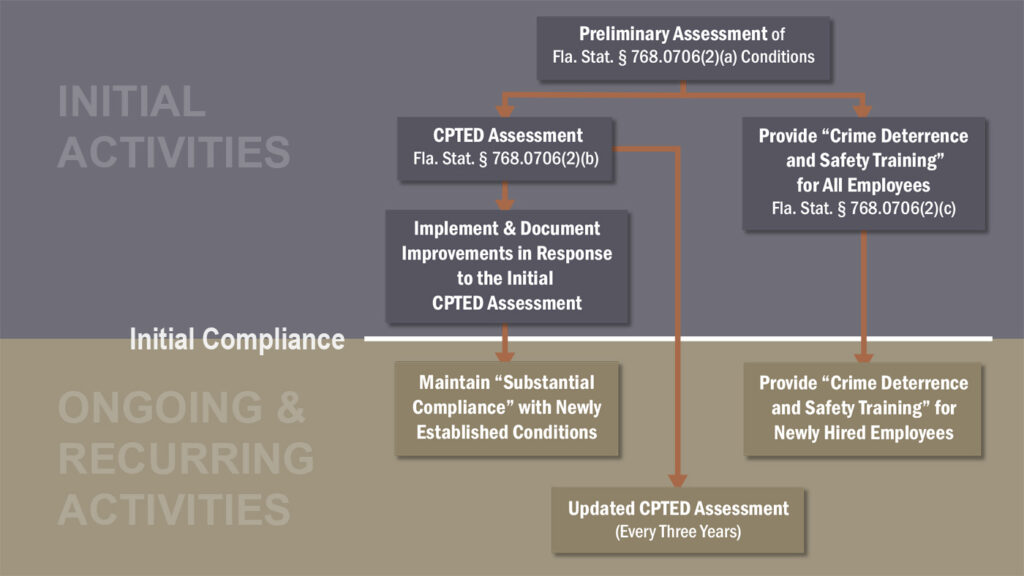
    • Obtain a CPTED assessment completed and documented by a law enforcement agency or a Florida Crime Prevention Through Environmental Design Practitioner (FCP) no more than three years old. F.S. 768.0706(2)(b) further requires that property owners remain in mostly in “substantial compliance” with the assessment.
    • Provide proper crime deterrence and safety training to current employees by January 1, 2025. After this date, offer such training to all employees within 60 days of hiring.

Implementing these measures allows you to take advantage of the presumption against liability outlined in F.S. 768.0706(2) and reduce the risk of being held responsible for criminal acts committed by third parties on your property. Always stay informed about any updates or amendments to the bill, and consider consulting a legal professional from CIS to ensure full compliance.

It is highly recommended to conduct a preliminary assessment before the actual CPTED survey. This assessment helps property managers and owners determine the extent of work needed to achieve compliance and establish whether it is realistically possible to become compliant. Beyond the itemized conditions specified in HB 837, Florida Crime Prevention Through Environmental Design assessments encompass a much broader range of issues (e.g., landscaping design and maintenance, illumination in areas other than parking lots, etc.) and property owners will be expected to be in compliance with far more conditions than suggested by the list in F.S. 768.0706(2). Engaging in a documented CPTED assessment without knowing the costs and implications of compliance could lead to increased liabilities and vulnerability to plaintiff attorney complaints if the property fails to meet the required standards.

To minimize potential liability risks, consider the following steps before engaging in a full CPTED assessment:

    1. Perform a preliminary assessment with a qualified security professional: Review the requirements of HB 837 and evaluate your property’s current security measures against the criteria specified in F.S. 768.0706(2) and common CPTED standards. This will help identify areas that need improvement.
    2. Consult with a professional: Seek advice from a property management consultant, security expert, or legal professional to discuss your preliminary findings and understand the potential consequences of non-compliance.
    3. Develop a plan: Based on the self-assessment and expert advice, create a plan outlining the steps, resources, and timeline needed to bring your property into compliance.
    4. Communicate with stakeholders: Inform your team, residents, and other relevant parties about the planned improvements and their potential impact on property operations and safety.
    5. Monitor progress: Regularly review the implementation of the plan to ensure that improvements are made according to the established timeline, and adjust the plan as needed.

By taking these steps, you can minimize potential liability risks and be better prepared for a formal CPTED assessment. Keep in mind that achieving compliance is an ongoing process that requires continuous monitoring and improvement. Stay informed about any updates or amendments to HB 837 and collaborate with experts and local authorities to maintain a safe and secure environment for your residents.

Facebook
Twitter
LinkedIn
Email

The MetroWest Program: A Case Study in Proactive Public Safety

Map of MetroWest Orlando

The MetroWest Program: A Case Study in Proactive Public Safety

MetroWest is celebrating the seventh year of partnership with Critical Intervention Services (CIS), a Florida‐based security agency that specializes in enhancing public safety through its Safe Communities Programs.

The CIS Safe Communities Programs focus on two key principles to contribute to the overall public safety of the communities they help protect. First, CIS focuses on connecting with community stakeholders, residents, businesses, property managers, local law enforcement partners, and security providers. Second is the character of the officers hired, with the hiring process for Public Safety officers rivaling most law enforcement agencies by including intense screening/interviewing, testing, education and prior experience requirements.  

“Having officers with strong character is extremely important as our Public Safety Officers (PSO)  must establish trust with our community members,” said Shannon Bryson, MetroWest Public Safety Director. “MetroWest PSOs serve as community liaisons, building relationships with community members, businesses, the Orlando Police Department (OPD), and other law enforcement officials and entities.”

MetroWest Master Association General Manager Julie Sanchez became aware of CIS in 2013 when she was approached at a multi-family/community association management tradeshow.

“At first, I thought that CIS would be just another security provider vendor. Then I sat down with CIS to learn more about their community-based methodology and I realized that this was the partner MetroWest Master Association needed,” Sanchez said.

CIS was engaged by the MetroWest Master Association to take a deeper dive into the public safety issues MetroWest was experiencing. An 18-month study revealed the tremendous importance of community stakeholders – including law enforcement, local security, property managers, local businesses and residents – all working together for public safety. The study also showed a disconnect within the community with regard to the perception of crime versus the reality. During the 18 months of the study, CIS looked at  crime statistics for MetroWest specifically and engaged community members and stakeholders about their perceptions of crime in the community. The results showed that the perception of crime within MetroWest did not match the actual crime statics, letting CIS know this too would need to be addressed. 

As a result, the first of its kind in the country “Private Sector Led Public Safety Program” was born as part of the larger “Safe Communities Programs” that CIS focuses on throughout their operations. The program is based on the unique methodology of the Community and Character Based Protection Initiative (CCBPI), which focuses on establishing trust, building relationships and connections among community members. This unique methodology educates, allows and encourages community members and stakeholders to actively take a role in their own public safety.  

Building Relationships: The Key to Proactive Public Safety

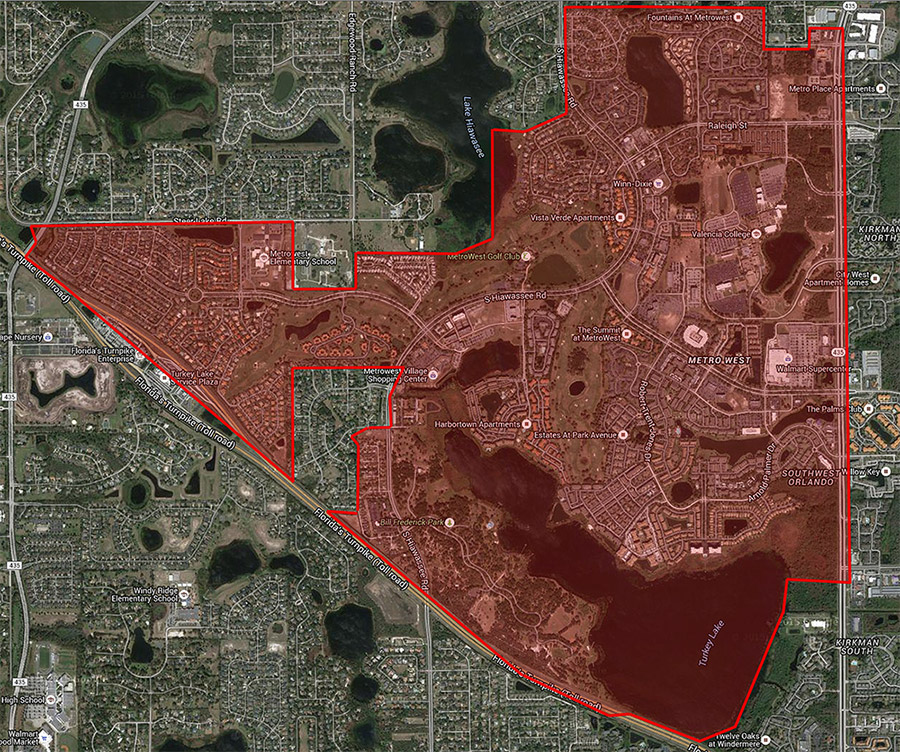
MetroWest as a whole consist of 36 residential communities and more than 500 commercial businesses with more than 100 of those being retail. MetroWest Public Safety Officers travel within the communities and commercial areas on foot, bicycles, and in public safety vehicles to get to know community members, get them connected, and educate them about the Public Safety Program.

In 2019, MetroWest PSOs were involved in more than 22,000 community/business contacts within MetroWest, a clear indication that the program is unifying owners, businesses, managers and residents to promote the highest standards of public safety.

“Our Private Sector Led Public Safety Program is tailored to MetroWest’s specific needs and is based on establishing trust and building relationships and connections among community members,” said Bryson. “We have seen that creating and maintaining those community connections has strengthened the social capital of MetroWest.”

Metrowest

Proactive Public Safety Program Success

The success of the CIS Safe Communities Program is dramatically evident when comparing crime and resident turnover rates in the MetroWest area between 2013 (when the program started) and 2017:

      • 16 percent overall decrease in auto theft
      • 45.8 percent overall decrease in vandalism
      • 16.3 percent overall decrease in violent acts
      • 63.9 percent overall decrease in residential burglary
      • Residential property managers reported 95-98 percent occupancy rates and 65-70 percent renewals in 2017, with a 2-5 percent increase year-by-year of the program.

MetroWest Master Association and CIS, along with OPD, have also facilitated the process by which MetroWest communities can implement the principles of Crime Prevention through Environmental Design (CPTED) in order to achieve Crime Free Certification from OPD. Attaining Crime Free Certification is a three-phase process, requiring an eight-hour certification class, inspections by both the Orlando Police Department and Orlando Utilities Commission, and fulfilling Crime Prevention Through Environmental Design requirements.

In all, 11 MetroWest communities have received Crime Free Certification, with continued efforts to achieve the goal of all communities becoming Crime Free.

Since becoming the first community in the United States to adopt the CIS Private Sector Led Public Safety Program, MetroWest has built strong and effective partnerships with OPD, local residents, business owners and other community organizations, which have led to demonstrable positive results such as rental retention and increase rents and home values year over year.

“The MetroWest Public Safety Program is a cornerstone of our effort to make MetroWest a great place to Live, Work, Play and Connect,” said Sanchez. “We envision the continued success of our Public Safety Program because it has definitely proved since its conception that a connected community is a protected community.”

Simple tips for a safer community from MetroWest Public Safety:

    • Report! Your eyes and ears are value added to our public safety strategy.
    • Engage! Get to know your neighbors. If you look out for them, they are more likely to look out for you.
    • Be mindful! Unlocked homes and cars and open garages are an invitation for opportunistic criminals. Bicycles and valuable items left in yards can quickly disappear.
    • Think first! Do not confront or follow suspicious persons or individuals engaging in criminal activity. Call 911 or report the matter to the Orlando Police Department.
Facebook
Twitter
LinkedIn
Email

We offer a range of services to assist communities in reducing crime and improving quality of life 

Learn more about the CIS Safe Communities Program and our proactive public safety strategies.

5 Common Issues Contributing to Premises Liability in Apartment Communities

Premises Liability and Apartment Communities

5 Common Issues Contributing to Premises Liability in Apartment Communities

When it comes to reducing premises liability in apartment communities and multi-family housing, an old adage provides best advice:

“An ounce of prevention is worth a pound of cure.”

Yet despite this wisdom, many in the apartment industry remain persistent targets of lawsuits with reliance on insurance and legal strategy as the main defense against premise liability.

Although these types of “consequence management measures” are a universal element of managing risk, we have witnessed numerous situations over the past few years where even the best legal defense did little to protect against multi-million dollar verdicts.

A Structured Approach to Reducing Premises Liability Risk in Apartment Communities and Multi-Family Housing

A more evolved strategy for reducing liability risk implements a structured approach to security and safety aimed at preventing lawsuits and establishing conditions that limit vulnerability in the courtroom. In addition to reducing liability, effective security can improve the quality of life for residents by reducing crime and improving the residents’ perception of safety. This has the added benefit of reducing resident turnover and increasing property values by reducing vandalism.

5 Common Security Negligence Issues Contributing to Premises Liability in Apartment Communities and Multi-Family Housing

As a security consultant, I work exclusively in aiding property owners and managers in reducing liability through effective security and safety. I do this by assessing properties for conditions of concern and presenting recommendations for security and environmental improvement and management practices which reduce crime and positively influence human behavior and resident perceptions.

Although every property I work with is unique, certain problems seem to be recurring themes during my assessment activities. For purposes of this article, I’ll narrow our focus to the five most common issues contributing to criminal confidence and social and physical disorder within residential properties.

1. Lighting

Illumination

Ensuring that properties are well-illuminated is one of the most basic principles of natural surveillance in Crime Prevention Through Environmental Design (CPTED). A well-illuminated property:

      • Deters criminal activity by increasing the likelihood of a criminal being witnessed in the act.
      • Additionally, effective CCTV imaging requires adequate illumination to ensure proper documentation of persons and activity.
      • And beyond crime prevention, lighting is an important function of environmental safety and reduces the risk of nighttime accidents on property.

However, despite the importance of lighting and its potential influence on premise liability, this is a common issue in many of our property assessments.

To ensure lighting meets essential standards, it is recommended that a lighting assessment is conducted to systematically measure illumination levels in different locations using a light meter. Illuminance (the measure of how much the light illuminates a surface or area) is measured in foot-candles (FC) or lux. 1 FC is the amount of light that hits a 1 square foot surface when 1 lumen is shined from 1 foot away – which equates to 1 lumen per square foot.

Recommended Illumination Levels for Multi-Family Residential Properties

As consultants, we employ conservative CPTED guidelines and standards promoted by ASIS International as a basis for identifying locations with insufficient illumination. For instance:

CPTED & ASIS Illumination Guidelines

Although these guidelines are largely universal, many municipalities have lighting ordinances that may deviate from these guidelines and should be consulted as part of the assessment and design process.

Lighting Uniformity

Another important aspect of lighting is uniformity. Lighting uniformity affects our perception of the environment and our ability to safely navigate its features (e.g., walkways, stairs, etc.). Uniform lighting allows us to perceive the environment continuously and without sudden breaks caused by lighting level drops. Uniformity of lighting levels also impacts people’s perception of safety and security. Simply put, well-lit and uniformly illuminated areas make pedestrians feel more secure. A poorly lit parking lot, with severe variation (contrast) between peak and minimum illumination levels, feels darker, less secure, and may embolden criminal confidence.

To ensure uniformity, the type of light distribution pattern should be properly matched to the purpose. Following is a summary of light distribution patterns and recommended applications.

    • Type I distribution is a two-way lateral distribution having a preferred lateral width of 15 degrees in the cone of maximum candlepower and is great for lighting walkways, paths, and sidewalks. This type of lighting is meant to be placed near the center of the pathway. This provides adequate lighting for smaller pathways.
    • Type II light distributions have a preferred lateral width of 25 degrees and are used for wide walkways, on ramps and entrance roadways, as well as other long, narrow lighting. This type is meant for lighting larger areas and usually is located near the roadside. You’ll find this type of lighting mostly on smaller side streets or jogging paths.
    • Type III light distributions have a preferred lateral width of 40 degrees. This type has a wider illumination area if you make a direct comparison to type II LED distribution, and is meant for general roadway lighting, parking areas and other areas where a larger area of lighting is required.
    • Type IV distributions produce a semicircular light meant for mounting on the sides of buildings and walls. It’s best for illuminating the perimeter of parking areas and businesses. The intensity of the Type IV lighting has the same intensity at angles from 90 degrees to 270 degrees.

Modern LED light sources allow LED luminaires to more evenly dissipate light over large areas than HID (High-Intensity Discharge) light sources. Because LED lighting can more evenly illuminate an area, the space appears brighter and feels more secure. Replacing HID lighting with LED systems is a common recommendation in my reports. LED lighting also has excellent color rendition, meaning that light reflecting off the surface of objects displays the color more accurately. This makes it easier to accurately identify the color of a vehicle or the clothes an offender is wearing.

One of the most common issues I encounter during my assessments is insufficient illumination in places designated for human activity (e.g., sidewalks, playgrounds, parking lots, picnic areas, breezeways, mailboxes, residential building entrances, etc.). This is predominantly caused by the following issues:

    • Existing lights obstructed by trees, shrubbery, dirt, or insects.
Premises Liability and Apartment - Light Obstruction
    • Non-functional lights (e.g., burned-out light bulbs, damaged photocells, malfunctioning or incorrect ballasts, etc.)
Premises Liability and Apartment - Broken Lights
    • Incorrect usage of light types. For example, converting to LED lighting without properly retrofitting the fixture.
    • Insufficient illumination sources.
    • Incorrect light distribution types.
    • Light glare due to lack of shielding.
Premises Liability and Apartment - Glare Lighting

To assist clients in remedying lighting problems, we typically conclude our assessments by preparing a detailed lighting map identifying all luminaires on the property, the type of light fixtures in use, problematic lights, and metered illumination levels in locations so that problematic areas are clearly recognized. Specific recommendations for improvement are then submitted in the main body of the assessment report.

Lighting Map

2. CCTV / Cameras

Poorly designed and/or maintained CCTV systems are another common problem in residential properties. Common issues include:

    • Obstructed cameras
    • Improper positioning of cameras
    • Limited DVR storage
    • Insufficient illumination to support effective use of cameras
    • Malfunctioning or inoperative cameras

To address these problems, we recommend that property managers conduct a weekly camera inspection to ensure cameras are functioning properly and identify developing problems such as overgrown vegetation, etc. The inspection should ideally be conducted during nighttime since the cameras often appear to perform well during daytime, but may suffer under nighttime lighting conditions due to things like cobwebs, obstructions, and malfunctioning infrared illuminators.

Premises Liability and Apartment - CCTV Problems

We also commonly recommend using motion sensors for lights illuminating interior spaces under camera surveillance (e.g., clubhouses, fitness rooms, etc.). Lights activated by motion sensors can alert people when other individuals are present nearby, limit offender concealment, and provide indoor cameras with good illumination.

3. Landscaping

Landscaping design and maintenance also play an important role in crime prevention. As a symbolic barrier, landscaping can mark the transition between “zones,” define the property boundary, and discourage casual trespass. Landscaping can also serve as a barrier against committed intrusion when dense hedges or aggressive shrubbery are used.

When conducting assessments, I often encounter obstructed cameras and lights due to overgrown shrubbery, untrimmed trees, and other landscaping features. Overgrown shrubbery and untrimmed trees also provide an opportunity for offender concealment and embolden criminal confidence by restricting natural surveillance between residential units, parking lots and other areas designated for human activity. Overgrown shrubbery and untrimmed trees can result in liability issues.

A common recommendation in my reports is implementing a CPTED principle called the 2-feet/6-feet rule. Bushes and hedges are not to be taller than 2 feet, and tree canopies are not to be lower than 6-feet near areas designated for human activity. This approach ensures that visibility between three and six feet from the ground will always be relatively unimpaired.

CPTED Landscaping

4. Documenting crime, community rule violations, and nuisance activities

Reducing social disorder and evicting problematic residents is another critical aspect of crime prevention in multi-family housing. This includes ensuring we have good documentation of crimes on a property, community rule violations, and nuisance activities in preparation for potential eviction. In many properties I assess, it is just a handful of bad apples amongst the resident population which are responsible for many crimes on property and community perceptions of fear. Left unaddressed, this situation can lead to higher resident turnover rates, lower occupancy rates, property damage, and liability issues.

Documenting on hardcopy solely can lead to loss of documentation in case of fire, flooding, etc. so it is important to store your documentation in your property management software for example.

5. Security officers

Security officers are the property manager’s eyes and ears when the property manager is not on site. And if used correctly, it can function as a deterrent to crime and improve resident perceptions of safety.

Unfortunately, very few properties I assess effectively use security officers. Sometimes this problem results from security officers with inadequate training and skills. At other times, the property manager fails to define the officers’ duties and expectations for performance.

When contracting a security company or a courtesy officer for the property, the expectations and duties of officers should be clearly established. These expectations should be ideally defined in a ‘scope of work’ to the contract, or in the form of post orders for the property.

Security officers assigned to patrol the property need to be aware of locations where criminal or nuisance activity is common, and any units or residents of concern. Proper documentation by security officers in the form of a daily activity report increases the property manager’s awareness of activities occurring when the property staff is absent. The property manager can correspondingly take action to make the property a safer place.

Facebook
Twitter
LinkedIn
Email