
What Counts as a “Point of Entry and Exit”? The Most Consequential Ambiguity in Fla. Stat. 768.0706
Of the seven physical security measures itemized in Fla. Stat. 768.0706(2)(a), the first appears to be the simplest: a security camera system at points of entry and exit that records, and maintains as retrievable for at least 30 days, video footage sufficient to assist in identifying and apprehending offenders. Property owners read that sentence, count their entrance drives, and check the box. On simple properties with a handful of clearly identified entrance drives and sidewalks, this type of simplified analysis may be accurate. However, on many properties, that reading can be easily misleading. The statute never defines what constitutes a “point of entry and exit,” and the answer a property assumes can differ dramatically from the answer a plaintiff’s attorney will argue after an incident.
What does Fla. Stat. 768.0706(2)(a)(1) actually require?
The requirement has three components, and each carries its own compliance exposure. The camera system must cover the property’s points of entry and exit; footage must remain retrievable for at least 30 days; and the recorded image quality must be sufficient to assist in identifying individuals or vehicles passing through those points. The second and third components are operational conditions rather than installation specifications — a system that met them on installation day can quietly fall out of compliance as cameras are added and storage becomes inadequate, imaging quality deteriorates, or vegetation grows. But it is the first component, the coverage requirement, that contains the statute’s most consequential undefined term.
The ambiguity of the term “point of entry and exit”
The statute provides no definition, and until Florida courts resolve the question through case law, no one can say with certainty where the requirement ends. What can be said with certainty is who bears the risk of guessing wrong: the statute places the burden of proof on the owner or principal operator to demonstrate substantial implementation of the required measures. A property that counted conservatively and covered three points will not be arguing with us about the definition. It will be arguing with an opposing expert who is inclined to count expansively, under deposition, after an incident occurred when the presumption against liability hinges on the court’s interpretation of “substantial compliance.” That asymmetry is why our team applies a prudent working assumption: any designed point of passage between exterior public space and the private space of the property may qualify as a “point of entry and exit” under the statute.
What does a prudent approach to camera coverage and Fla. Stat. 768.0706(2)(a)(1) encompass?
Applied in the field, the assumption may encompass more than owners expect. Every vehicle entrance drive qualifies. So does every sidewalk entering the property from exterior public space — pedestrian points of passage are “points of entry and exit” in every sense that matters to the statute’s purpose. Where unofficial entry points exist, such as a foot trail worn through the property line, prudence may justify measures to prevent future foot traffic or covering those as well: the path’s existence demonstrates that people use it. And for vertical properties in urban settings, exterior doors adjacent to public space — a building entrance opening directly onto a public sidewalk — may also qualify. The common thread is the property line/legal boundary: the analysis begins not with where management assumes people enter, but with every designed crossing between public and private space.
The property that went from three points to twenty
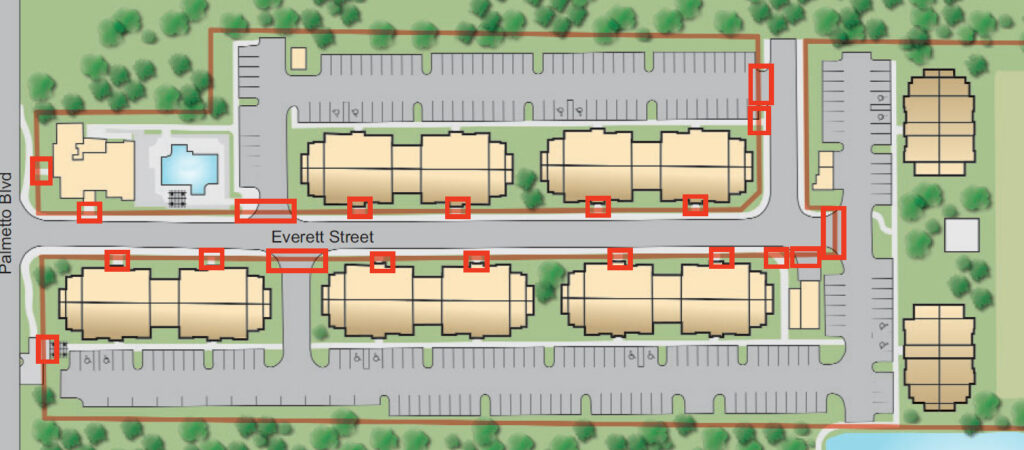
This counting problem is illustrated well by a case from our assessment practice. At first glance, the property (a garden-style community) appeared to have three points of entry and exit: two sidewalks entering from the boulevard on its western boundary, and one entry road with adjacent sidewalks. Three points, three cameras, straightforward compliance.
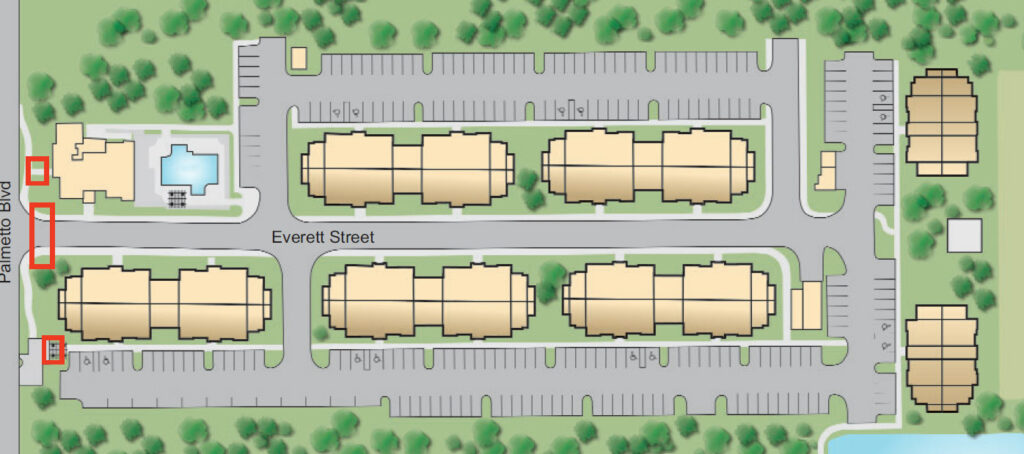
However, examination of the property appraiser’s map told a different story. The street running through the middle of the community was not a private drive — it was a public road, dividing the property into two separate sections, and the sidewalks along it were public space as well. Once the property’s actual boundaries were established, every vehicle entrance from that road and every sidewalk approaching the breezeways of the buildings along it became possible “points of entry and exit.” The complete count was twenty.
An even more complex situation arises often with high-rise apartment properties built in structural adjacency to commercial facilities and public parking garages. In several properties we’ve assessed of this type, the number of “points of entry and exit” ranged between 28 and 36 when all doors connecting public areas from the private inner space of the property were tallied.
To be clear, these cases are outliers — most properties we assess have between one and seven qualifying points under our interpretation guidelines. But the example demonstrates why the count must be established from the property’s legal boundaries (as defined by the property appraiser’s map) or careful analysis of floor plans where relevant.
What does undercounting potentially cost?
The obvious cost is the corrective one: in our recent findings analysis of 30 Florida multifamily properties, camera coverage gaps at points of entry and exit appeared on 77% of properties, and camera system corrections ranged from roughly $2,000 for coverage additions to $50,000 or more where systems required replacement.
The less obvious cost is the evidentiary one. A property that undercounted has not merely left a gap in coverage — it has created the precise fact pattern that undermines defensible compliance with Fla. Stat. 768.0706(2)(a)(1): an uncovered point of passage and a record that shows the property drew the definitional line in its own favor. The expense of covering a marginal point is knowable and bounded. The expense of defending the decision not to cover it is neither.
Counting is the beginning, not the end
Identifying the points is the first half of compliance; keeping them covered is the second. Retention must survive operational reality, and every new camera added to a system shrinks the retention window for all of them. Image quality must actually support identification at each covered point, which is a nighttime question as much as a resolution question. And vegetation is the quiet saboteur: trees and shrubbery that were not pruned with camera sight lines in mind can partially or fully obstruct coverage of a “point of entry and exit.” The most common scenarios are overgrown trees blocking a camera’s view of an entry drive or sidewalk where it crosses the property line, converting a covered point into an uncovered one without anyone touching the camera system. Property staff should know the location of every designated point, verify weekly that each camera covering one is functioning and unobstructed, and generate a work order immediately when one is not.
Where this fits in your compliance sequence
The point-counting analysis belongs at the beginning of the compliance process — during the preliminary review, before any formal assessment documents the property’s conditions. Counting honestly at that stage lets a property correct coverage gaps before they become findings in a discoverable report. Our compliance guide explains the preliminary assessment sequence in detail, and our practitioners perform this boundary analysis as a standard component of every 768.0706 engagement. If your property’s count was established by assumption rather than analysis, it is worth revisiting. And preferably before a plaintiff has a reason to count for you.

Craig Gundry
Contact Us
Contact us for a free consultation about Fla. Stat. § 768.0706 compliance by calling Tel. +01 (727) 461-9417 or by completing the following form: